Free Dyscalculia Test: Symptoms, Guide & Checklist by Age
Does the world of numbers feel like a foreign language? For many, the persistent struggle with math isn't about a lack of effort but may be related to underlying learning differences. If you've ever wondered, "Do I have dyscalculia or am I just bad at math?", you've come to the right place. This guide offers a clear, compassionate look at the signs of dyscalculia across different life stages, helping you recognize the patterns and understand the next steps. Recognizing these signs is the first empowering move towards clarity and support.
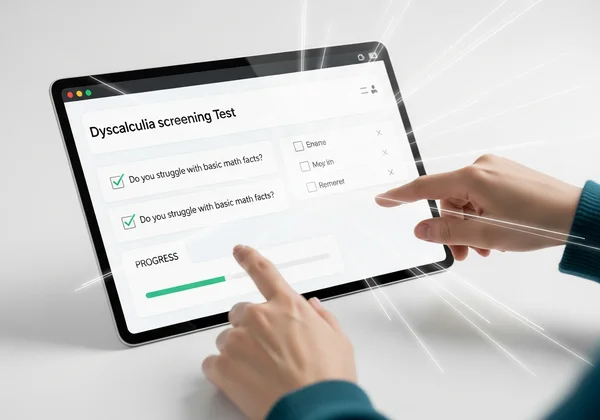
This comprehensive guide will walk you through the common symptoms, provide a helpful checklist, and show you how to gain deeper insight. Understanding your unique cognitive profile is key, and an initial screening can be a valuable starting point. You can begin exploring this with a free dyscalculia test designed by experts.
Understanding Dyscalculia: More Than Just 'Bad at Math'
It's a common misconception to equate dyscalculia with simply being "bad at math." This view overlooks the neurological basis of this specific learning difference. Dyscalculia is about how the brain processes numerical information, not a reflection of a person's intelligence or willingness to learn. Understanding this distinction is crucial for building self-esteem and finding effective strategies.

What Exactly is Dyscalculia? Defining a Math Learning Difference
At its core, dyscalculia is a specific and persistent difficulty in understanding numbers and mathematical concepts. Often described as "math dyslexia," it impacts a person's foundational "number sense." This can make it challenging to grasp quantity, remember math facts, and perform calculations accurately and fluently. This is more than a simple struggle; it's a different way of seeing and interacting with the world of numbers. Recognizing this math learning difference is the first step toward finding the right support.
Dyscalculia vs. Math Anxiety vs. Low Achievement: Key Distinctions
It's vital to differentiate dyscalculia from other challenges. Math anxiety is an emotional response—a feeling of fear or tension when faced with math—which can hinder performance but is not a cognitive processing issue itself. Low achievement could stem from various factors, such as inadequate instruction or lack of practice. Dyscalculia, however, is a persistent, brain-based difficulty that remains even with quality teaching and support. Identifying the root cause is essential for finding the right path forward, which often begins with a proper online screening.
Early Dyscalculia Signs: Preschool & Elementary Years
For parents and educators, identifying the signs of dyscalculia early can make a significant difference in a child's academic journey and confidence. The foundational years are when number sense develops, and early red flags often appear in a child's everyday play and learning.

Preschool-Age Dyscalculia Symptoms: Early Red Flags in Number Sense
In young children, before formal math education begins, the signs are often related to the building blocks of numeracy. Keep an eye out for these early indicators of number sense challenges:
- Difficulty learning to count, often skipping numbers.
- Trouble recognizing printed numbers (e.g., confusing '3' with '8').
- Struggling to connect a number symbol (4) to its quantity (four apples).
- Difficulty sorting objects by shape, size, or color.
- Needing to use fingers to count long after peers have stopped.
Elementary School Struggles: Numbers, Operations, and Time
As children enter elementary school and math becomes more structured, the symptoms can become more apparent. The struggles often expand beyond basic counting to include more complex tasks.
- Persistent difficulty recalling basic math facts (e.g., 2+3=5).
- Trouble understanding concepts like 'greater than' or 'less than'.
- Challenges with telling time on an analog clock.
- Making frequent errors in simple addition and subtraction.
- Difficulty with word problems and understanding the steps needed to solve them.
If these signs resonate, a dyscalculia test for child can offer initial clarity and direction.
Dyscalculia Symptoms in Teens: Navigating Advanced Math
The transition to middle and high school introduces more abstract mathematical concepts, which can significantly amplify the challenges for teenagers with dyscalculia. The focus shifts from concrete arithmetic to symbolic reasoning, a common area of difficulty. This is often where a dyscalculia test teenager can be particularly insightful.
Dyscalculia in Teens: Algebra, Geometry & Abstract Concepts Challenges
As math becomes more complex, so do the symptoms. The struggle is no longer just with basic calculations but with understanding the very language of mathematics.
- Difficulty understanding variables in algebra (like 'x' and 'y').
- Trouble with multi-step problems and keeping track of information.
- Challenges with visualizing shapes and understanding spatial relationships in geometry.
- Inability to grasp the concepts behind formulas, often relying purely on memorization.
Organization & Time Management Difficulties Beyond Numbers
The impact of dyscalculia in teens often extends beyond the math classroom. The same cognitive processes that affect number skills can also influence executive functions. This includes challenges with time management, organizing assignments, estimating how long a task will take, and reading charts or graphs in other subjects like science and social studies.
Adult Dyscalculia Symptoms: Everyday Life & Career Impact
For many adults, the math challenges they faced in school never truly went away. They simply found ways to cope or avoid situations involving numbers. Recognizing the dyscalculia test for adults symptoms can be a validating experience, explaining lifelong struggles that were often dismissed as personal failings.

Financial Management & Budgeting Struggles
One of the most significant impacts for adults is on financial literacy. Everyday financial tasks can feel overwhelming and induce anxiety.
- Difficulty creating and sticking to a budget.
- Trouble calculating tips, sales tax, or discounts at stores.
- Anxiety when dealing with bank statements or balancing a checkbook.
- Making frequent errors in mental math required for daily transactions.
- Struggling to estimate the total cost of groceries in a cart.
Spatial Reasoning, Direction, and Estimation Challenges
Dyscalculia isn't just about numbers; it often involves difficulties with spatial awareness and estimation, which can affect daily life in surprising ways.
- Trouble reading maps or following sequential directions.
- Frequently getting lost, even in familiar areas.
- Difficulty judging speed and distance, which can make driving stressful.
- Struggling to estimate quantities for cooking or measurements for DIY projects.
If these experiences feel familiar, it's never too late to seek understanding. A confidential online dyscalculia test can be a powerful first step.
Dyscalculia Symptom Checklist: A Self-Assessment Guide
This dyscalculia checklist is designed to be a tool for reflection. It is not a diagnostic instrument but can help you identify patterns that may warrant further exploration. Go through the list and see how many of these experiences resonate with you or your child.
How to Use This Checklist to Identify Potential Signs
Read through the statements below. Consider whether these challenges are occasional or persistent and if they cause significant frustration or anxiety. A consistent pattern of difficulty across multiple areas could suggest an underlying learning difference.
- For Children & Teens:
- Has trouble remembering phone numbers or game scores.
- Struggles to tell time on an analog clock.
- Finds it hard to understand charts and graphs.
- Avoids games that involve numbers or strategy.
- Has difficulty with concepts of money and making change.
- For Adults:
- Feels high anxiety when needing to do math unexpectedly.
- Often runs late due to poor time estimation.
- Has difficulty calculating tips or splitting a bill.
- Struggles with mental math and relies heavily on a calculator.
- Has trouble remembering numerical information like PINs or dates.
When to Consider Further Steps: Beyond the Checklist
If you checked several items on this list, it may be time to take the next step. This checklist is a starting point, but a more structured assessment can provide a clearer picture. Exploring these signs through an expert-designed testing for dyscalculia can provide the personalized insights you need to move forward with confidence and strategy.
Empowering Understanding: What Your Symptoms Could Mean
Recognizing the symptoms of dyscalculia is not about applying a label; it's about gaining understanding and finding empowerment. These signs are simply clues to how your brain, or your child's brain, processes information. With this knowledge, you can unlock new strategies, find supportive tools, and build a path to success that honors your unique cognitive style.
Ready to explore further? Our free, expert-designed Dyscalculia Test can provide personalized insights into your unique math learning profile. This initial screening is a simple, confidential way to understand potential challenges and strengths. Take the first step today and transform confusion into clarity.
Frequently Asked Questions About Dyscalculia Symptoms & Testing
What are the very first signs of dyscalculia in young children?
The earliest signs often appear before formal schooling and relate to foundational number sense. This includes difficulty learning to count in sequence, struggling to connect a number like "4" to a group of four items, and an inability to recognize number patterns, such as on dice.
Can adults suddenly develop dyscalculia symptoms?
True dyscalculia is a developmental learning difference, meaning it has been present since childhood. However, adults may only become aware of their symptoms later in life when new job demands or life responsibilities increase their need to use math skills. In rare cases, math difficulties can be acquired after a brain injury or stroke, which is known as acalculia.
Is there a reliable, free test for dyscalculia online?
Yes, there are online screening tools that can help identify the signs of dyscalculia. While they are not a substitute for a formal clinical diagnosis, a high-quality, free screening can be an excellent starting point. The test at our free dyscalculia screening tool is designed by educational psychologists and math experts to provide a reliable initial assessment and can even generate a personalized AI-driven report to guide your next steps.
How is dyscalculia different from dyslexia or ADHD?
While they can co-occur, they are distinct conditions. Dyslexia is a learning difference that primarily affects reading and language processing. Dyscalculia specifically impacts the ability to process numerical and mathematical information. ADHD affects executive functions like attention and impulse control, which can impact math performance, but the root cause is different from the number-sense deficit seen in dyscalculia.