A Parent's Guide to Dyscalculia Tests for Teens: Signs, Options & Next Steps
Seeing your teenager struggle with high school math while excelling in subjects like English or History can be confusing and deeply frustrating. You might watch them spend hours on algebra homework, only to end up in tears, or notice they still count on their fingers when calculating simple change. As a parent, you may wonder if they are just "bad at math" or if there is an underlying issue like a math learning disability.
You are not alone in this worry. Many cases are missed in elementary school, only becoming obvious when academic pressure increases. This guide covers everything you need to know about a dyscalculia test for teenager needs, from recognizing age-specific red flags to understanding your options for assessment. By the end, you will have a clear path to help your teen get the answers and confidence they deserve. If you want a quick baseline to organize what you’re observing, you can explore an online dyscalculia screening test as a starting point.

Is It Dyscalculia or Just Math Anxiety? Understanding the Difference
Before looking for any test, it helps to clarify what you may be seeing. High school is demanding, and math anxiety is common. Sometimes anxiety is the main barrier. In other cases, anxiety grows on top of a long-running difficulty with numbers.
The goal here is not to label your teen quickly. It is to separate (1) a persistent difficulty with number concepts from (2) the stress response that can make any hard subject feel impossible.
The Number Sense Gap: The Core Issue
Dyscalculia is often described as a math learning disability. In practical terms, it can involve difficulty building strong “number sense” — an intuitive grasp of quantity, magnitude, and numerical relationships.
A teen with math anxiety may understand the concept but freeze during tests. A teen with dyscalculia may also work hard yet struggle with the underlying logic of numbers. For example, they might not notice that an answer like 5,000 is wildly off for a problem involving small amounts. Over time, needing extra mental effort for basic number processing can be exhausting.
The Anxiety Loop: Cause vs. Effect
You may hear comments like “They just need to relax” or “They have a mental block.” But if your teen has struggled with numbers for years, anxiety may be a secondary reaction to repeated frustration.
Under pressure, stress can make working memory and focus worse. That can amplify a number-processing difficulty during tests, timed quizzes, and homework. A dyscalculia test for teens can help you clarify what is likely skill-based, what is stress-based, and what supports might help with both.
Red Flags in High School: Dyscalculia Symptoms in Teenagers
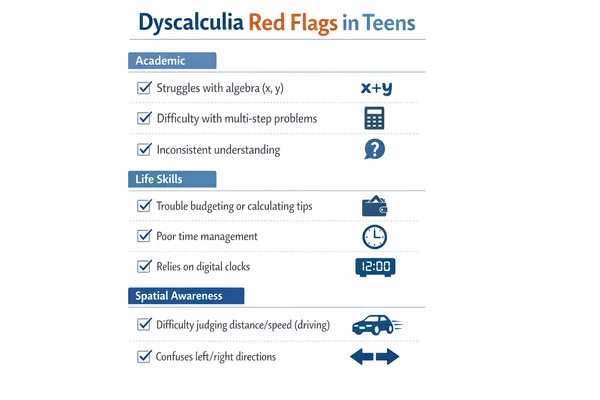
Dyscalculia symptoms in teenagers can look different than in younger children. Many teens develop coping strategies, such as memorizing steps without truly understanding them. Those strategies can start to break down as math becomes more abstract.
Academic Struggles: Algebra, Geometry, and Chemistry
In high school, the curriculum moves from arithmetic to abstract reasoning. This is often where the "invisible" wall appears.
- Algebra: Variables like $x$ and $y can feel slippery, and multi-step manipulation may overload working memory.
- Geometry: Rotating shapes mentally and tracking spatial relationships can be hard.
- Science class: Chemistry and physics may feel unexpectedly difficult because they depend on measurements, formulas, and conversions.
- Inconsistency: They may seem to “get it” one day and lose it the next, especially when problems change format.
Life Skills: Money Management and Telling Time
Dyscalculia affects more than just grades; it impacts a teenager's growing independence. These signs often go unnoticed because parents don't associate them with math.
- Money Management: They may struggle to budget their allowance, estimate the total cost of items in a shopping cart, or calculate a tip.
- Time Management: They might be chronically late because they cannot accurately estimate how long "20 minutes" feels or how long it takes to get ready.
- Reading Analog Clocks: Many teens with dyscalculia still rely entirely on digital clocks.
Spatial Awareness: Driving and Navigation
One of the most significant milestones for a teenager is learning to drive. Dyscalculia can impact spatial awareness, making this milestone more challenging.
- Judging Distance: They may have trouble gauging how far away a car is or when to begin braking.
- Navigation: Reading maps or following "left/right" directions quickly can be confusing.
- Physical Coordination: Some teens may appear clumsy or struggle with sports that require judging the speed and trajectory of a ball.
How Do I Get My Child Tested for Dyscalculia: 3 Common Paths
If the symptoms above sound familiar, your next question is likely: "How do I get my child tested?" There is no single blood test for dyscalculia. Instead, it involves an evaluation of cognitive skills. You generally have three paths, each with pros and cons depending on your goal.
Here are three common routes, each with trade-offs.
School Evaluations (IEP and 504 Plans)
In the United States and many other countries, public schools are legally required to evaluate students suspected of having a learning disability.
- Pros: It is free, and if the school finds a disability, they are legally bound to provide an Individualized Education Program (IEP).
- Cons: The process is notoriously slow, often taking months. Furthermore, schools test to see if a student qualifies for special education, not necessarily to give a medical diagnosis. If your teen is passing (even barely), the school might deny the request for testing.
Private Clinical Assessments (Neuropsychologists)
This is the gold standard for a medical diagnosis. You would see an educational psychologist or neuropsychologist for a battery of tests.
- Pros: You get a comprehensive report that is widely accepted by colleges and standardized testing boards (like the College Board for SATs).
- Cons: It is expensive (often costing between $1,000 and $4,000) and usually not covered by insurance. Waitlists can also be six months or longer.
Online Screening Tools (Preliminary Assessment)
For many parents, the gap between suspecting an issue and paying thousands for a doctor is too wide. This is where an online dyscalculia test fits in.
- Pros: Immediate, private, and low-cost (or free). It validates your concerns and gives you data to decide if the expensive clinical route is necessary.
- Cons: Most online tools are screeners, meaning they indicate risk but do not provide a legal medical diagnosis.
Why Start with an Online Dyscalculia Screening
Before you fight for a school meeting or spend money on a specialist, it is helpful to have a clear baseline. Using a online dyscalculia test serves as a bridge between suspicion and action. It allows you to gather objective data about your teen's cognitive profile in a low-pressure environment.
Faster Clarity While You Plan Next Steps
Waiting months for a formal appointment can be hard during high school. A screener can help you name patterns sooner, so you can adjust expectations, reduce conflict around homework, and plan supports more intentionally.
A Simple Profile, Not Just a Label
Dyscalculia does not look the same in every teen. Some struggle more with visual-spatial tasks, while others struggle more with memory for number facts or multi-step sequencing.
A screening result can help you describe your teen’s challenges more specifically, which can be useful when you are deciding what to request from school or what to ask a clinician to evaluate.
After the Results: Getting Proof for SAT/ACT Accommodations
If your screening results indicate a high likelihood of dyscalculia, you might be worried about college entrance exams. High-stakes testing is often where accommodations are most needed.
When You Need a Formal Diagnosis
It is important to be transparent: an online screening result is generally not enough to grant extra time on the SAT or ACT. The College Board requires a formal diagnosis from a qualified professional (school psychologist or private doctor) and a history of the disability impacting schoolwork.
However, taking the dyscalculia test teenager screening is an excellent piece of evidence to bring to that doctor's appointment. It shows you have done your homework and provides the specialist with a roadmap of symptoms to investigate.
Common Accommodations for Dyscalculic Students
Once diagnosed, teenagers can access level-playing-field adjustments that make a massive difference:
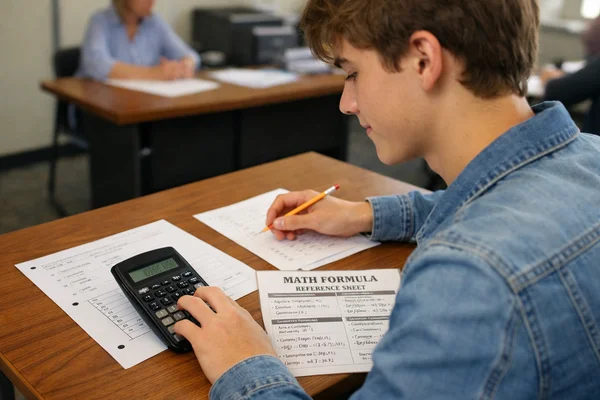
- Extended Time: Usually 50% more time on math sections.
- Calculator Use: Permission to use a calculator on sections where it is usually forbidden.
- Quiet Testing Location: To minimize distraction and anxiety.
- Reference Sheets: Access to a sheet with formulas so they don't have to rely on rote memory.
Moving Forward: Supporting Your Teen’s Journey
earning that dyscalculia may be part of your teen’s experience is not “bad news.” It can be a useful explanation for why effort has not matched results — and a starting point for better support and self-confidence.
If you are deciding what to do next, here is a simple path you can follow:
- Write down patterns you notice (when math is hardest, what triggers shutdown, what types of problems are easier).
- Talk with teachers or counselors about observed difficulties and ask what supports are available now.
- Use a screener to organize your notes if that feels helpful, then bring it to the conversation.
- Request a school evaluation or private assessment if school performance, stress, or testing needs make documentation important.
- Support confidence and identity by separating self-worth from math performance and highlighting strengths.
If you’d like a low-pressure way to begin, you can start with an online dyscalculia assessment and treat it as one piece of information in a bigger picture. The goal is clarity, support, and a plan that fits your teen.
Frequently Asked Questions
Is it too late to test for dyscalculia at 17?
No, it is never too late. While early intervention is ideal, diagnosing dyscalculia in the late teen years is very common. Understanding the condition at this age is crucial for selecting the right college path, securing accommodations, and learning workplace coping strategies.
Can you test for dyscalculia online for free?
Yes, there are reputable free screening tools available online, such as the one on our site. These tools analyze your answers to provide a risk assessment and cognitive profile. However, keep in mind that a free online test is for educational purposes and is not a substitute for a formal clinical diagnosis required for legal documents.
What is the difference between dyscalculia and being bad at math?
Being "bad at math" can result from missed lessons, poor instruction, or lack of interest, and can usually be improved with standard tutoring. Dyscalculia is a neurodevelopmental disorder affecting the brain's ability to process numerical information. A student with dyscalculia may struggle with basic number logic despite excellent tutoring and high effort.
How much does a private dyscalculia test cost?
A full neuropsychological evaluation typically costs between $1,000 and $4,000, depending on your location and the specialist's credentials. This is why many parents start with a free or low-cost online dyscalculia screening to determine if a full evaluation is warranted.