Anxiety, Anger, Guilt, and Sadness Are Referred to as Affect: What That Means
Anxiety, anger, guilt, and sadness are referred to as affect in psychology, especially when they are discussed as felt emotional states. More specifically, they are often grouped under negative affect, a broad term for unpleasant feelings such as fear, distress, irritability, shame, and sadness. That does not mean these emotions are bad, wrong, or a sign that something is seriously wrong. It means they share a negative emotional tone and can shape attention, behavior, learning, and social reactions. For students, parents, and adults exploring math stress, free dyscalculia screening and learning resources can offer a calm educational starting point alongside professional support when needed.
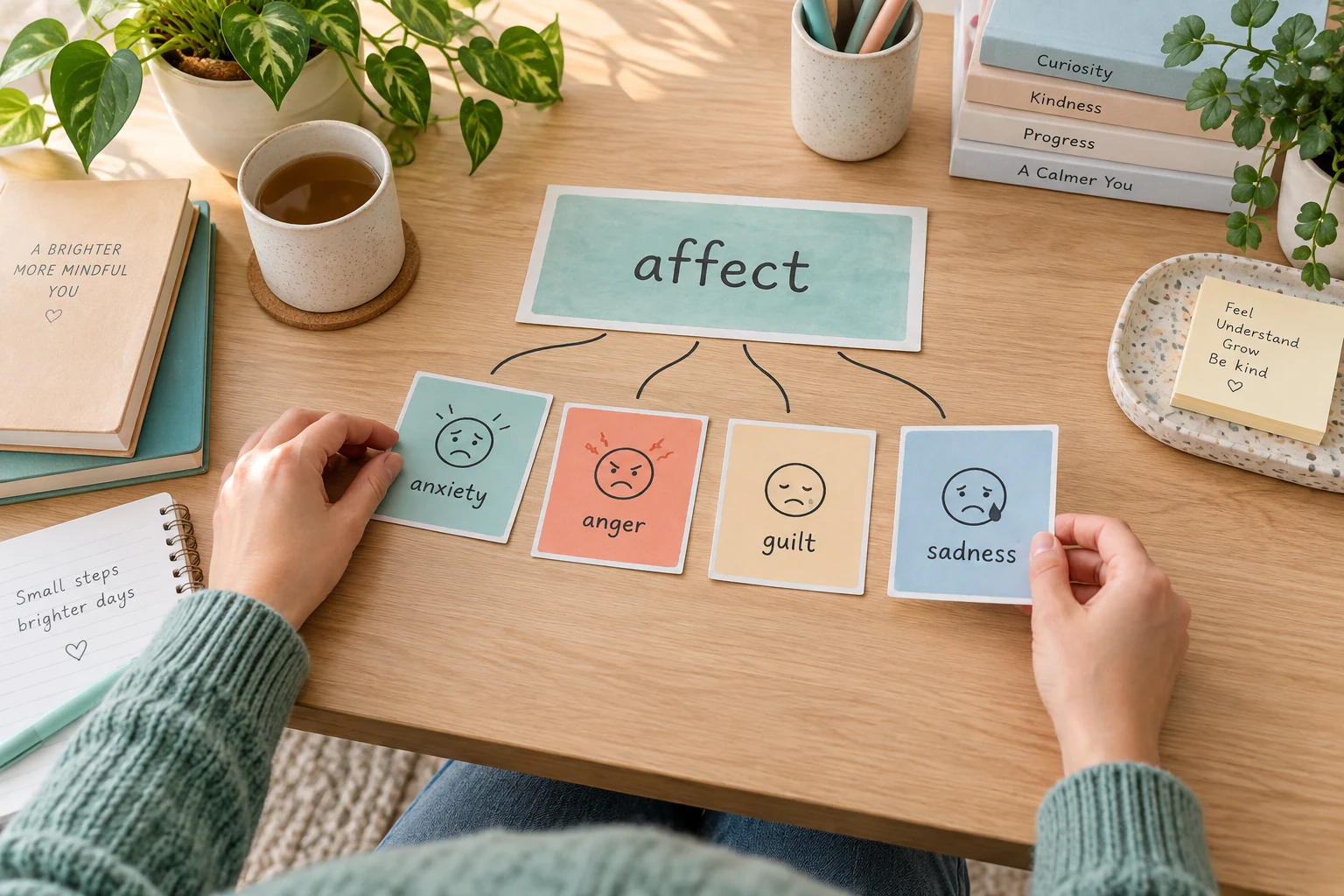
The Short Answer: These Feelings Are Forms of Affect
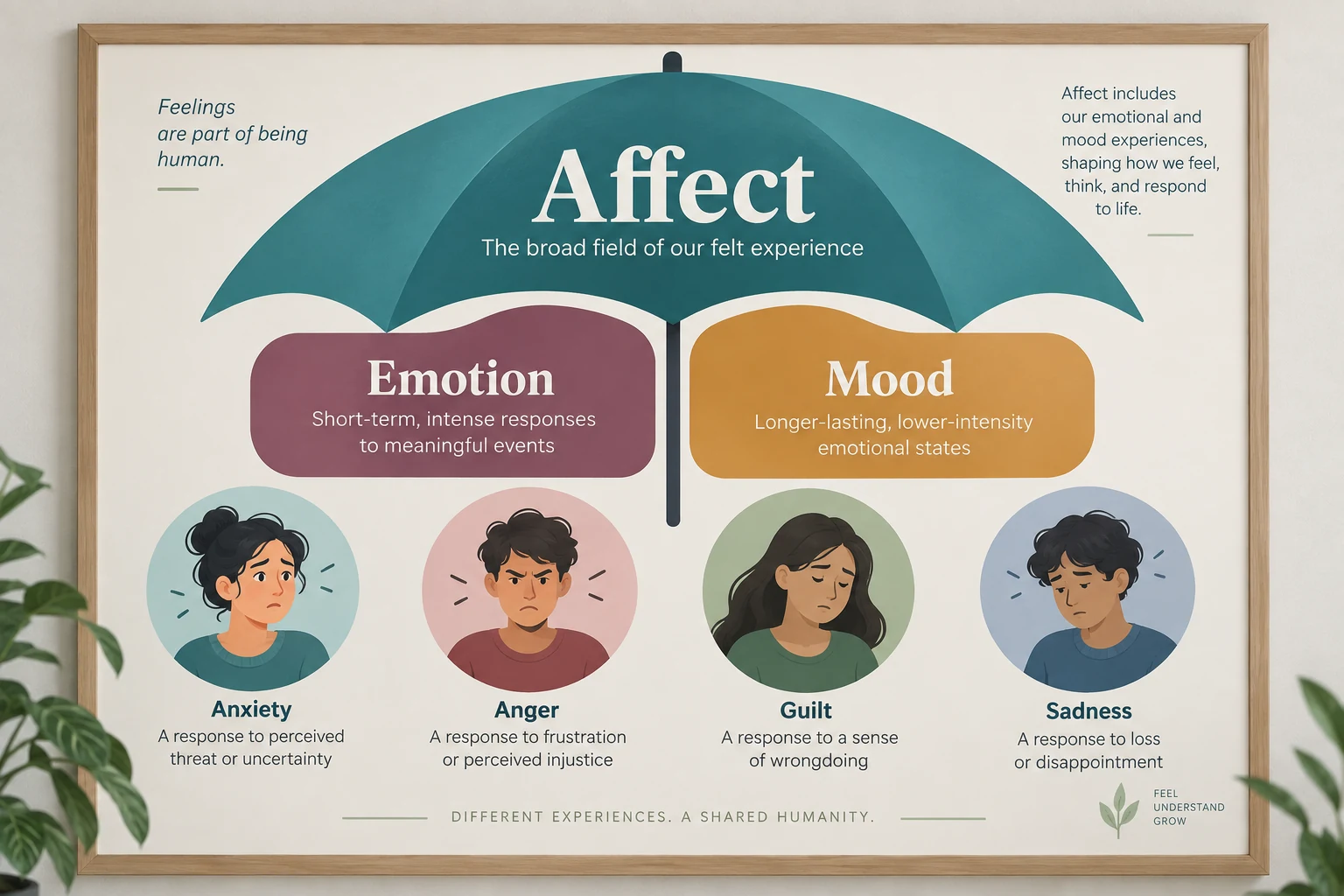
In psychology, affect is a broad umbrella for the experience or expression of feeling and emotion. It can include emotions, moods, and the tone of an emotional state. When a quiz asks, "anxiety anger guilt and sadness are referred to as," the expected answer is usually affect.
If the answer choice says negative affect, that is usually even more precise. Anxiety, anger, guilt, and sadness all tend to feel unpleasant, activate the body, and pull attention toward a problem, threat, loss, mistake, or social concern. They are not identical emotions, but they live in the same broad family of negative emotional experience.
It helps to separate three related terms: emotion is usually a specific response, mood is often more diffuse and longer-lasting, and affect is the broad category that can include both.
So the clean answer is: anxiety, anger, guilt, and sadness are referred to as affect, and often as negative affect when the focus is their unpleasant emotional tone.
Affect Is Not the Same as a Mood Disorder
A common source of confusion is the overlap between everyday emotion words and mental health terms. Feeling anxious, angry, guilty, or sad is part of human life. These emotions may appear during conflict, academic pressure, social embarrassment, grief, uncertainty, or repeated frustration with a difficult task.
A mood disorder, by contrast, involves patterns that are more persistent, intense, and disruptive to daily functioning. Anxiety can also exist on its own or alongside mood concerns, but anxiety itself is commonly classified separately from mood disorders.
For an informational article, the safest distinction is this: affect is a psychology term for emotional experience; it is not, by itself, a label for a disorder. That distinction matters because students can internalize repeated academic struggle as a personal flaw. A child who feels panic before math, anger when corrected, guilt about needing help, or sadness after another poor grade may be showing understandable emotional responses to repeated difficulty.
Why Negative Affect Can Show Up Around Math
Negative affect often appears when the brain reads a situation as threatening, unfair, overwhelming, or personally meaningful. For someone with a history of math difficulty, even a small task can carry a large emotional load. The worksheet is not just a worksheet; it may feel like another chance to be judged, rushed, corrected, or exposed.
This is one reason math anxiety can become so powerful. Anxiety may narrow attention and make working memory feel crowded. Anger may appear when a learner feels trapped. Guilt may follow if the person believes they are disappointing others. Sadness may arrive after repeated experiences of trying hard and still falling behind.
Those emotions can also interact. A student might feel anxious before a quiz, angry during it, guilty afterward, and sad later that evening. Adults can experience the same pattern with budgeting, forms, time estimates, tips, measurements, or workplace numbers.
For dyscalculia-related content, this is where language can become empowering. Naming the emotional category as affect does not solve the math problem, but it gives the learner a less shame-based way to describe what is happening.
Parents and educators can also use this frame gently. Instead of asking, "Why are you overreacting?" they can ask, "Which feeling is loudest right now: worry, frustration, guilt, or sadness?" A learner who can identify the feeling may be more ready for a break, a visual tool, a slower explanation, or a different way into the problem. If math challenges are frequent, math learning reflection tools can help families organize observations before deciding whether to seek a fuller educational evaluation.
Can Anxiety Cause Anger Outbursts?
Anxiety can contribute to anger outbursts, especially when a person feels cornered, embarrassed, overstimulated, or unable to escape a demand. Anger sometimes functions like a protective response that interrupts a task or covers more vulnerable feelings.
This does not mean every angry reaction is "really" anxiety. Anger is its own emotion, and sometimes it is a direct response to unfairness, pressure, or frustration. But anxiety and anger often travel together because both can involve physical arousal.
In learning situations, an outburst may be less about defiance and more about overload. A child who shouts during math practice may be communicating, in an unskilled way, that the task feels threatening.
A practical response is to lower the intensity before returning to the task. Use a short pause, fewer problems, visual supports, or a choice between two next steps.
What Are the 7 Core Emotions?
There is no single universal list of "the 7 core emotions" used by every psychologist. Different theories organize emotions in different ways. Some models focus on basic emotions such as happiness, sadness, anger, fear, disgust, and surprise. Other emotion-education models use a different set of core feelings and treat anxiety, guilt, or shame as protective emotions.
For a student answering a quiz, the safest move is to look at the textbook or course model being used. If the question is connected to the phrase "anxiety, anger, guilt, and sadness are referred to as," it is probably testing the broader concept of affect, not asking for a full list of basic emotions.
For everyday learning support, the exact list matters less than the habit of naming emotions accurately. "I feel anxious and guilty because I keep losing my place" gives a parent, teacher, or tutor more useful information than "I feel bad."
What Is a Mix of Anger and Sadness Called?
A mix of anger and sadness does not have one required name. People may describe it as hurt, grief, resentment, disappointment, bitterness, discouragement, or emotional pain, depending on the cause and context.
The same two emotions can mean different things. After teasing, anger plus sadness may feel like hurt. After losing an opportunity, it may feel like grief or disappointment. After repeated unfair treatment, it may feel like resentment.
In other words, mixed affect is normal. During academic struggle, a learner may feel angry that math is so difficult and sad that effort has not brought the expected progress. Both feelings can be real at the same time.
The useful question is not "What is the perfect label?" but "What does each feeling want me to notice?" Together, anger and sadness may show that the learner needs both practical support and emotional reassurance.

How Biology, Experience, and Feedback Shape Affect
Related searches often ask whether emotions are influenced by biological foundations and individual experience. The short answer is yes. Emotional life is shaped by the body, the brain, temperament, memory, social learning, culture, and current circumstances.
Biology can influence how strongly someone reacts to stress and how quickly their body settles. Experience can teach the brain what to expect. If numbers have often led to embarrassment, the body may prepare for danger before the person has time to think through the situation.
Feedback can also matter. The facial feedback hypothesis proposes that facial movement and expression may influence emotional experience. This does not mean smiling fixes distress or posture erases anxiety. It simply reminds us that emotion is not only a thought; it is also physical.
That is why support strategies often work best when they address both the task and the body: clearer steps, slower pacing, a quieter setting, movement, breathing space, or reassurance that struggle is not failure.
A Simple Way to Name Affect During Learning Stress
When emotions are intense, a short labeling routine can help before homework, during tutoring, or after a difficult classroom moment.
Try this four-step check-in:
- Name the task. "I am working on fractions," "I am reading a bill," or "I am estimating time."
- Name the affect. "I notice anxiety," "I notice anger," "I notice guilt," or "I notice sadness."
- Name the body cue. "My chest feels tight," "my face feels hot," or "my stomach dropped."
- Name the next support. "I need a pause," "I need a visual example," or "I need one step at a time."
This routine is not therapy, and it is not a substitute for professional care when distress is severe or ongoing. It is an educational self-reflection tool that shifts the question from "What is wrong with me?" to "What is happening, and what support would help?"
Teachers and parents can model the same language: "This looks frustrating. Let's reduce the number of problems and use a number line first." That response validates affect while still supporting the learning goal.
Using Affect Language to Make Math Support Kinder
The phrase "anxiety anger guilt and sadness are referred to as affect" may look like a quiz answer, but it can also be a useful doorway into self-understanding. Affect language helps separate the learner from the emotion. A person is not "bad at trying" because they feel anxious, angry, guilty, or sad. They are experiencing negative affect in a situation that may need clearer support.
For dyscalculia and math anxiety, that distinction is important. A screening tool cannot replace a qualified professional's evaluation, and no article can explain one person's full learning profile. But careful self-observation can help users notice patterns: which tasks trigger stress, which supports reduce it, and whether math difficulty has been persistent across time and settings.
If number-related stress is affecting school, work, or daily life, a gentle math learning self-check can be one low-pressure way to gather observations. Pair that with teacher input, family notes, and guidance from qualified educational or healthcare professionals when concerns are significant. The goal is not to label every feeling. The goal is to make learning support more accurate, humane, and useful.
FAQ
Anxiety, anger, guilt, and sadness are referred to as what?
They are referred to as affect. Because they usually feel unpleasant, they may also be described as negative affect. In psychology, affect is a broad term for emotional experience, emotional tone, mood, or feeling.
Is affect the same thing as emotion?
Not exactly. Emotion is usually more specific, such as anger about an unfair comment. Affect is broader and can include emotions, moods, and general feeling tone. In many classroom contexts, affect is the umbrella term.
Is negative affect always harmful?
No. Negative affect can be uncomfortable, but it can also signal that something needs attention. Anxiety may point to uncertainty, anger to blocked goals or unfairness, guilt to values or responsibility, and sadness to loss or discouragement.
Can math anxiety include anger and guilt?
Yes. Math anxiety can appear with frustration, anger, guilt, embarrassment, avoidance, or sadness. Those feelings may be especially strong when a learner has experienced repeated struggle, time pressure, public correction, or shame around numbers.
What is the relationship between anger and social anxiety disorder?
Anger and social anxiety can overlap when a person feels judged, embarrassed, rejected, or trapped in a social situation. This article is educational, so anyone concerned about intense or persistent symptoms should speak with a qualified mental health professional.
What should I do if emotions are blocking learning?
Start with a short pause, name the feeling, reduce the task size, and use concrete supports such as examples, visuals, or step-by-step prompts. If emotional distress is strong, frequent, or affecting daily functioning, it is wise to seek guidance from a qualified professional.