Dyscalculia and Autism Spectrum Disorder: Signs, Overlap, and Support
Dyscalculia autism spectrum disorder overlap can be confusing because autism and math difficulty do not always mean the same thing. Some autistic children and adults are strong visual thinkers, pattern spotters, or detail learners, yet still find number sense, mental arithmetic, time, money, or word problems unusually hard. Others struggle with math because of attention, sensory overload, language processing, anxiety, or classroom fit rather than dyscalculia itself. If you are trying to understand that difference, a gentle math learning difficulty screening starting point can help you organize observations before speaking with a qualified professional.
This guide explains how dyscalculia and autism spectrum disorder can overlap, how they can differ, what to watch for in adults and children, and what kinds of support are usually more helpful than simply asking someone to practice harder.

How Dyscalculia and Autism Spectrum Disorder Can Overlap
Dyscalculia is commonly described as a specific learning difference involving numbers and mathematical processing. It may affect quantity sense, arithmetic facts, estimating, sequencing, place value, time, measurement, and everyday number tasks. Autism spectrum disorder, or ASD, is broader. It affects social communication, behavior, sensory processing, interests, routines, learning style, and daily functioning in different ways for different people.
The overlap matters because both profiles can affect math performance. An autistic learner may have difficulty shifting between steps, tolerating noisy classrooms, interpreting word problems, or explaining how they solved a problem. A learner with dyscalculia may have a more direct difficulty with number magnitude, counting principles, arithmetic facts, or mental calculation. When both are present, the experience can feel layered: the numbers are hard, the instructions are hard, and the environment may also be hard.
It is also important not to flatten autistic math profiles into one stereotype. Some autistic people enjoy advanced math, coding, patterns, maps, statistics, or systems. Others find school math painful even when they are bright, verbally skilled, or highly knowledgeable in other subjects. The question is not whether autism automatically causes dyscalculia. The better question is: which part of the math task is breaking down, and what support matches that pattern?
Dyscalculia Symptoms That May Look Different in Autistic Learners
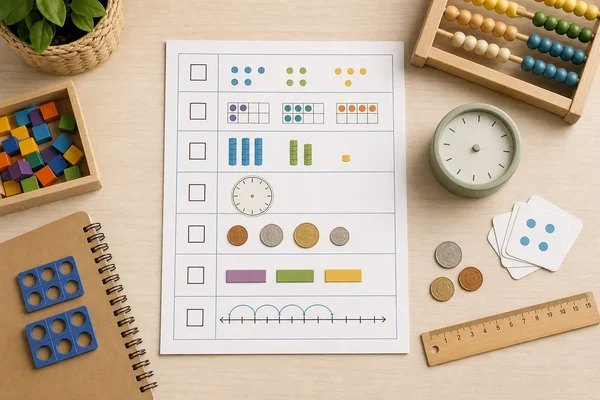
Core dyscalculia symptoms often involve persistent difficulty with number-based thinking. Signs may include slow counting, trouble comparing quantities, difficulty remembering math facts, frequent calculation errors, weak estimation, confusion with place value, difficulty reading analog clocks, trouble counting money, or needing visual supports long after peers have moved on.
In autistic learners, those signs may be complicated by communication style and context. A child might know an answer but struggle to explain it verbally. A teen may perform better with written steps than spoken instructions. An adult may manage work tasks well but avoid tipping, budgeting, schedules, or mental math because number pressure creates shutdown or avoidance. A learner may also look inconsistent: successful with a special-interest topic that uses numbers, but lost when the same operation appears in an unfamiliar format.
Watch for patterns across settings instead of relying on one test score or one classroom moment. Helpful questions include:
- Does the person understand quantity, order, and number size without over-relying on memorized procedures?
- Are arithmetic facts unusually hard to retain even with repeated practice?
- Do visual clutter, sound, time pressure, or social demand make math performance much worse?
- Does the person struggle more with word problems than with direct calculations?
- Are time, money, measurement, directions, or scheduling creating daily stress?
These questions do not label a person. They help parents, adults, and educators decide what kind of assessment, accommodation, or learning support may be worth exploring.
Autism and Math Difficulties Are Not Always Dyscalculia
One of the most useful distinctions is between primary number difficulty and math difficulty caused by surrounding demands. Dyscalculia usually points toward persistent challenges with number sense and mathematical processing. Autism-related math difficulty may come from other parts of the task: language, executive function, sensory load, flexible thinking, transitions, or anxiety.
For example, a word problem about sharing pizza may look simple on paper, but it asks the learner to process language, imagine a social situation, identify the relevant numbers, ignore distracting details, choose an operation, and show the work in the expected format. If the student can calculate 24 divided by 6 but freezes inside the story problem, the main obstacle may not be basic division. It may be language, inference, format, or cognitive flexibility.
On the other hand, if the learner cannot reliably tell which of two numbers is larger, loses track while counting, cannot retain basic facts, or finds number magnitude confusing even in calm one-to-one settings, dyscalculia should be considered as part of the learning profile. A low-pressure dyscalculia screening tool can be useful for collecting these patterns, as long as it is treated as educational information rather than a replacement for professional evaluation.
Dyscalculia and Autism in Adults
Dyscalculia and autism in adults can be missed for years, especially when the adult learned to compensate. Many adults build routines around avoiding math: using only digital clocks, choosing jobs with fewer number demands, memorizing routes instead of estimating distance, asking trusted people to check bills, or feeling embarrassed by tip calculations and scheduling mistakes.
For autistic adults, the picture can be even more subtle. Some may have been praised for intelligence, memory, or technical interests, so math difficulty was dismissed as laziness, anxiety, or lack of effort. Others may have masked confusion in school because asking for help felt socially risky. Adults may also discover the pattern only when life demands change: managing rent, taxes, medication timing, project budgets, parenting homework, or workplace data.
Adult support starts with reducing shame. Difficulty with numbers is not a character flaw, and it does not define intelligence. Practical next steps might include using visual budgeting tools, written checklists, calendar reminders, calculator-friendly workflows, structured templates, and accommodations where appropriate. If the difficulty is causing major work, school, or daily living problems, a psychologist, educational specialist, occupational therapist, or other qualified clinician can help clarify the full profile.

High-Functioning Autism and Math: Why the Term Can Mislead
People often search for high-functioning autism and math because they notice a mismatch: strong vocabulary, deep interests, or high test scores in some areas alongside surprising difficulty with everyday math. The phrase "high-functioning" is widely recognized, but it can hide support needs. A person may appear independent in conversation yet still struggle with working memory, sensory load, number sense, or multi-step math.
Math ability in autistic people is highly variable. Some autistic learners excel in system-based fields. Some have uneven profiles, such as strong pattern recognition but weak calculation fluency. Some are accurate when untimed but overwhelmed by speed drills. Some understand concepts but cannot show work in a conventional way. Others have both autism and dyscalculia, making number learning persistently difficult even with good instruction.
Instead of asking whether autism makes someone good or bad at math, look at the profile:
- Strengths: visual memory, detail focus, pattern recognition, intense interests, persistence.
- Barriers: working memory, flexible strategy use, sensory overload, math anxiety, language-heavy instructions.
- Number-specific concerns: quantity comparison, arithmetic facts, place value, estimation, time, money.
This profile-based view leads to better support because it avoids assuming that one label explains everything.
Dyscalculia and ADHD Alongside Autism
Dyscalculia and ADHD can also co-occur, and ADHD traits may intensify math challenges. Attention, working memory, impulse control, planning, and processing speed all matter in math. When ADHD, autism, and dyscalculia overlap, the learner may understand a concept one day but lose the steps the next day, especially under time pressure or sensory stress.
The support plan should not treat the person as a bundle of separate labels. It should identify what happens during real tasks. Does the learner skip steps because of attention? Misread symbols because of visual clutter? Forget procedures because of working memory load? Panic during timed tests? Lose the meaning of the numbers themselves? Each answer points to a different adjustment.
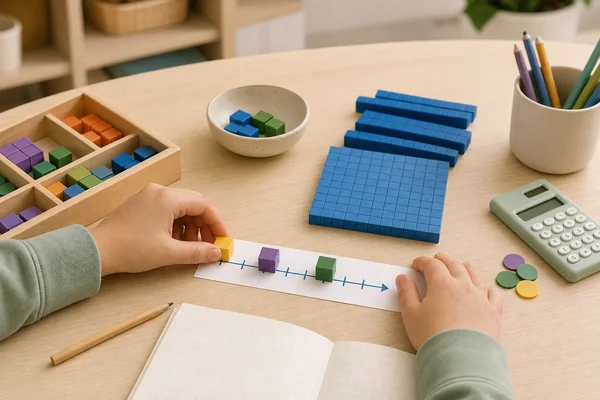
Common supports include shorter task sets, explicit worked examples, visual organizers, number lines, manipulatives, calculator access when calculation is not the skill being measured, extra time, reduced copy demands, predictable routines, and permission to use written steps. For many learners, confidence improves when adults stop framing support as a shortcut and start framing it as access.
Support Strategies for School, Home, and Daily Life
Helpful dyscalculia support is usually concrete, visual, and patient. For autistic learners, it should also respect sensory needs, communication style, routines, and interests. The goal is not to force one "normal" way of learning math. The goal is to build usable number understanding with less fear and more predictability.
In school, teachers can reduce unnecessary load by separating the math concept from handwriting, copying, speed, and social pressure. They can provide step cards, worked examples, graph paper for alignment, clear language, visual models, and untimed practice. Students may benefit from demonstrating understanding orally, with manipulatives, through a calculator-supported task, or in a quieter setting.
At home, families can practice math through real routines without turning every moment into a lesson. Cooking can support measurement. Board games can support counting and turn-taking. Calendar planning can support time. Grocery choices can support estimating and money sense. Keep the tone calm and brief. If a child is overwhelmed, the nervous system is not ready for more instruction.
For adults, support may look like practical design: labeled accounts, bill reminders, budgeting apps, written scripts for workplace calculations, time-blocking tools, travel buffers, and asking for reasonable adjustments when number tasks are not central to the job. What people often call dyscalculia treatment is usually a mix of educational intervention, accommodations, assistive tools, and emotional support.
What to Do Next If Both Profiles Seem Possible
If dyscalculia autism spectrum disorder overlap seems possible, start by gathering observations rather than rushing to a conclusion. Note which tasks are difficult, when the difficulty appears, what helps, and whether the same problem occurs in calm, supported settings. Include daily-life examples such as time, money, directions, measuring, scheduling, or scorekeeping.
For children, speak with teachers and ask for examples across math facts, concepts, word problems, classroom behavior, and test conditions. For adults, consider writing a short history of school math, current daily number demands, coping strategies, and situations that create the most stress. Then share that information with a qualified professional if the difficulty is affecting learning, work, independence, or well-being.
You can also review a free educational screening resource for number difficulties to organize your reflections. Screening is only a first step, but it can make the next conversation clearer and less overwhelming.

FAQ
Can you be autistic and have dyscalculia?
Yes. An autistic person can also have dyscalculia. Autism and dyscalculia are different profiles, but they can overlap. The key is to understand whether the math difficulty is mainly about number sense and arithmetic, autism-related task demands, attention, anxiety, sensory load, or a combination.
Is dyscalculia part of autism spectrum disorder?
Dyscalculia is not simply a part of autism spectrum disorder. It is usually discussed as a specific learning difference involving math and number processing. Autistic people may have dyscalculia, but autistic people can also have math strengths or math difficulties for reasons that are not dyscalculia.
What are common signs of dyscalculia in autistic adults?
Common signs may include long-term trouble with mental math, estimating, time, money, directions, schedules, measurement, remembering arithmetic facts, or following multi-step calculations. In autistic adults, these signs may be hidden by routines, avoidance, strong memory, or support from other people.
Does high intelligence correlate with autism?
Autism is a spectrum, so intelligence varies widely. Some autistic people have high measured intelligence, some have average scores, and some have intellectual disability. High intelligence does not rule out dyscalculia, ADHD, sensory difficulty, anxiety, or the need for practical support.
What is the life expectancy of someone with ASD?
There is no single life expectancy for everyone with ASD. Research discussions often focus on higher health and safety risks for some autistic people, especially when epilepsy, intellectual disability, mental health concerns, accidents, or barriers to care are present. Autism itself should not be treated as a simple life-span prediction. Individual health care, safety planning, communication support, and access to appropriate services matter.
Do all autistic people struggle with social cues?
No. Many autistic people experience social communication differences, but not everyone shows them in the same way or to the same degree. Some learn social patterns explicitly, some mask differences, and some communicate well in familiar settings but struggle under stress, ambiguity, or sensory overload.
Should I look for a dyscalculia test if autism is already identified?
It can be reasonable to explore dyscalculia screening if number difficulties are persistent, specific, and affecting school, work, or daily life. A screening tool can organize observations, but decisions about formal assessment and support should involve qualified professionals who can consider the whole learning profile.