Dyscalculia Classroom Strategies: Free Screening, Signs & Interventions
Are you an educator noticing students who persistently struggle with math, despite your best efforts? You see the frustration in their eyes when facing numbers, and you wonder if it's more than just a temporary learning gap. This guide is for you. It provides practical, evidence-based strategies to identify and support students with dyscalculia, helping you transform classroom challenges into opportunities for growth and confidence.
Understanding the root of a student's math difficulties is the first step toward effective support. A reliable screening can offer valuable initial insights. For a professional, expert-designed starting point, you can explore the free dyscalculia test available on our platform, a tool designed to help educators and parents identify key signs of math learning differences.
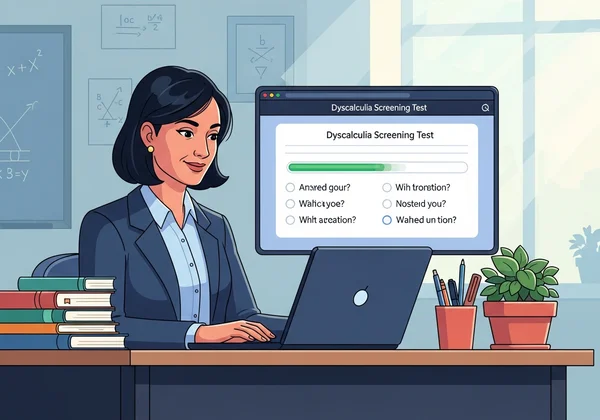
Identifying Dyscalculia Signs in Your Classroom
Before you can implement effective strategies, you need to know what to look for. Dyscalculia is more than just being "bad at math." It's a specific learning difference that affects an individual's ability to understand, learn, and perform math and number-based operations. Recognizing the signs early can make a significant difference in a student's academic journey.

Early Warning Signs of Dyscalculia in Children
The signs of dyscalculia can vary by age, but some common themes emerge in the classroom. Keep an eye out for students who consistently exhibit several of the following behaviors:
- Difficulty with Number Sense: They may struggle to grasp the concept of quantity, for example, not understanding that "5" is the same as five objects. They might have trouble subitizing (instantly recognizing the number of items in a small group) or comparing numbers (e.g., knowing if 8 is bigger than 6).
- Trouble Memorizing Basic Math Facts: While many students need practice with addition or multiplication tables, a student with dyscalculia may be unable to recall them despite repeated drills and practice.
- Reliance on Finger Counting: They may continue to count on their fingers for simple calculations long after their peers have moved on to mental math.
- Struggles with Place Value: Understanding concepts like ones, tens, and hundreds can be incredibly challenging, leading to errors in multi-digit addition or subtraction.
- Challenges with Time and Money: Telling time on an analog clock, managing allowance, or making change are real-world math skills that can be particularly difficult for them.
- Difficulty Linking Numbers and Symbols: They may struggle to connect a number like "4" to the word "four."
Differentiating Dyscalculia from Math Anxiety or General Learning Gaps
It's crucial to distinguish dyscalculia from other common issues. Many students experience math anxiety or have gaps in their learning due to missed instruction or other factors. So, how can you tell the difference?
- Math Anxiety is an emotional response. It's a feeling of tension and fear that interferes with math performance. A student with pure math anxiety gets the concepts when relaxed. But they freeze during tests. Dyscalculia, though, often causes that anxiety over time. Persistent failure due to a learning difference can naturally lead to anxiety.
- General Learning Gaps are often due to external factors. A student might have missed key concepts because of an illness, a move between schools, or a change in curriculum. With targeted review and practice, these students can usually catch up.
- Dyscalculia is a cognitive difference in how the brain processes numbers. The difficulty is persistent and doesn't improve significantly with standard teaching methods. The student struggles with the foundational concepts of numbers themselves, not just the procedures.
Observing a student's approach can provide clues. Do they struggle with the how (procedure) or the why (the underlying number concept)? If the struggle is foundational and persistent, it may be time to consider a screening.
Effective Teaching Strategies for Students with Dyscalculia
Once you suspect a student may have dyscalculia, you can adapt your teaching to better meet their needs. The goal is not to "cure" dyscalculia but to provide alternative pathways for learning and understanding. These strategies are often beneficial for all students in your classroom.
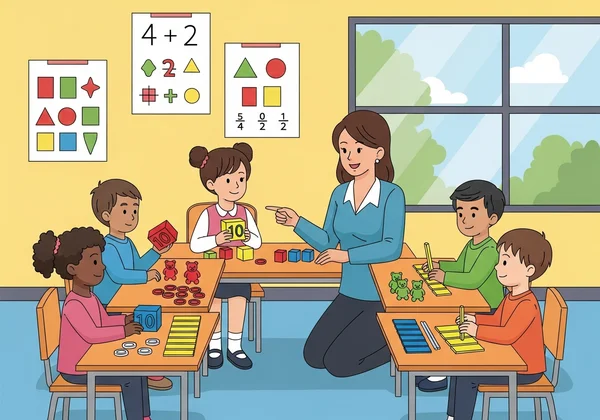
Adapting Lessons: Multisensory and Concrete Approaches
Students with dyscalculia often learn best when information is presented in multiple ways. A multisensory approach engages sight, sound, and touch to help solidify abstract concepts.
- Use Manipulatives: Don't be afraid to use physical objects, even with older students. Base-ten blocks, counters, fraction bars, and even simple items like beans or buttons can make abstract concepts concrete. Let students physically group, separate, and move objects to understand operations.
- Incorporate Visuals: Use graphs, charts, and diagrams to represent math problems. Encourage students to draw pictures of word problems. Using different colors for different steps in a long division problem, for instance, can help with organization.
- Make it Verbal: Have students talk through their problem-solving process. Explaining their steps out loud can help them organize their thoughts and allows you to pinpoint exactly where they are getting confused.
The Concrete-Pictorial-Abstract (CPA) approach is a highly effective framework. Start with hands-on objects (Concrete). Move to drawings (Pictorial). End with numbers alone (Abstract).
Fostering a Growth Mindset and Reducing Math Anxiety
The emotional component of math learning cannot be overstated. Students with dyscalculia often have a history of failure and frustration, which can lead to a fixed mindset—the belief that their math ability is unchangeable.
- Praise Effort, Not Just Answers: Focus on the student's process and persistence. Say things like, "I can see you worked really hard on that problem," or "That was a creative way to approach it," even if the final answer is incorrect.
- Reframe Mistakes: Teach students that mistakes are a normal and essential part of learning. Analyze errors as clues to what needs more practice, not as failures.
- Provide Ample Time: Timed tests are a major source of anxiety. Whenever possible, remove time pressure. Allow students to focus on accuracy over speed.
- Celebrate Small Wins: Celebrate every small win. This builds positive math memories. It counters years of frustration. Picture a classroom where kids tackle math without dread—that's the change you can spark. To better understand a student's unique profile of strengths and challenges, a personalized report from a screening tool can provide invaluable guidance.
Implementing Targeted Math Interventions for Dyscalculia
General strategies are a great start, but targeted interventions are often necessary for meaningful progress. These interventions should be structured, systematic, and focused on the student's specific areas of difficulty.

Personalized Learning Plans and Differentiated Instruction
There is no one-size-fits-all solution for dyscalculia. Differentiated instruction involves tailoring your teaching to meet individual needs.
- Break Down Skills: Teach concepts in small, sequential steps. Ensure a student has mastered one skill before moving on to the next.
- Pre-teach Vocabulary: Math has its own language. Explicitly teach terms like "sum," "denominator," and "product" before they appear in a lesson.
- Use Scaffolding: Provide tools like checklists for multi-step problems, multiplication charts, or partially completed examples to support students as they learn a new skill. Gradually remove these supports as they gain confidence.
Leveraging Educational Technology and Digital Tools
Technology can be a powerful ally. Many apps and software programs offer engaging, adaptive practice that can be customized to a student's level.
- Virtual Manipulatives: Websites and apps provide digital versions of base-ten blocks, geoboards, and other tools that can be less overwhelming than physical objects for some students.
- Math Game Apps: High-quality educational games can make drill and practice more engaging and less intimidating. Look for apps that provide immediate, corrective feedback.
- Calculators: Teach students to use a calculator as a tool, not a crutch. It can free up their cognitive resources to focus on problem-solving and higher-level thinking rather than getting stuck on basic computation.
Collaborating with Parents and Specialists for Comprehensive Support
You are a vital part of a student's support team, but you don't have to do it alone. Open communication and collaboration are key to creating a consistent support system for the child.
Team up with psychologists and special ed teachers. Build a full support plan together. They'll add deeper insights. It's also essential to partner with parents. Share your observations and strategies with them, and listen to their concerns. Recommending a resource like a free and accessible dyscalculia screening can be an excellent way to start a productive conversation. It provides parents with a concrete next step and empowers them with information to better support their child at home.
Empowering Every Student: Your Role in Dyscalculia Support
As an educator, you have the power to change a student's relationship with math. By recognizing the signs of dyscalculia, implementing supportive teaching strategies, and collaborating with a wider team, you can create a classroom where every student feels seen, understood, and capable of success. Your empathy and willingness to adapt your instruction can turn math from a source of fear into a subject of exploration and achievement.
This journey of support starts with understanding. If you suspect a student may be struggling with more than just typical math difficulties, encourage their parents to take the next step. Our free, expert-designed dyscalculia screening offers a confidential and comprehensive screening to help identify the signs of dyscalculia. Start the test today to access insights and unlock a path toward confident learning.
Frequently Asked Questions for Educators
How do you test for dyscalculia in students?
Testing for dyscalculia involves two stages. The first is screening, which identifies if a student shows signs consistent with a math learning difference. A formal diagnosis, however, must be conducted by a qualified professional, like an educational psychologist. A screening is an excellent, low-pressure first step to determine if further evaluation is needed.
What are the common signs of dyscalculia in children?
Common signs include a weak "number sense," persistent trouble recalling basic math facts (like 2+2=4), heavy reliance on finger counting, and difficulty understanding concepts like place value, time, and money. They may also show anxiety and frustration specifically related to math tasks.
Is there a free test for dyscalculia that I can recommend?
Yes. You can confidently recommend the free dyscalculia screening tool. It is a comprehensive, free online test designed by educational psychologists and math experts. After the screening, users can receive an optional AI-powered report that provides personalized insights and strategies, making it a valuable resource for both parents and educators. You can try our free tool to see how it works.
What are quick math interventions for dyscalculia in the classroom?
Some quick and effective interventions include: allowing the use of a multiplication chart for reference, using graph paper to help students align numbers in columns for multi-digit calculations, providing uncluttered worksheets with plenty of white space, and breaking down instructions into small, manageable steps.