Dyscalculia Test & Diagnosis: From Screening to Professional Assessment
Does struggling with numbers feel like a frustrating mystery? You might be closer to answers than you think. This guide cuts through the confusion, showing exactly how screening leads to professional support.
Understanding the Dyscalculia Diagnosis Process
Getting a formal diagnosis is a structured process designed to provide a clear and comprehensive picture of a person's learning profile. It goes far beyond a simple math quiz. It's about understanding the unique way a brain processes numbers and mathematical concepts. This process helps separate a true learning difference from other issues like math anxiety or gaps in education.
Why Formal Assessment Matters: Beyond Screening
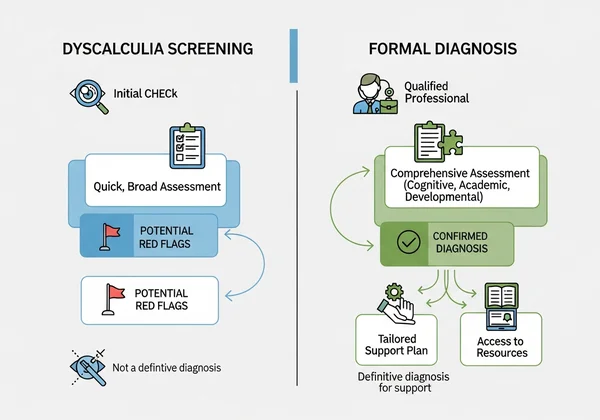
Online screening tools like our free dyscalculia test are incredibly valuable. They offer a private, accessible, and often free way to identify potential red flags for dyscalculia. They can give you the confidence to take the next step by confirming your concerns are valid.
However, a screening is not a diagnosis. A formal assessment is the definitive step required to:
- Get a Confirmed Diagnosis: Only a qualified professional can provide an official diagnosis of a Specific Learning Disorder with impairment in mathematics (the clinical term for dyscalculia).
- Access Accommodations: A formal diagnosis is often necessary to receive support in school (like an IEP or 504 plan) or accommodations in the workplace.
- Create a Tailored Support Plan: The detailed results from a professional evaluation provide a blueprint for effective, personalized support strategies.
Screenings indicate potential issues. Formal assessments confirm them. This detailed process unlocks tailored strategies and essential accommodations.
Who Can Diagnose Dyscalculia? Identifying the Right Specialists
A dyscalculia diagnosis must be made by a qualified professional with expertise in learning disabilities. You can't get a diagnosis from a family doctor or a math tutor. The key specialists to look for include:
- Educational Psychologists: These experts specialize in understanding how people learn. They are often the go-to professionals for assessing learning differences in school-aged children.
- Clinical Psychologists: They can diagnose dyscalculia and also rule out or identify co-occurring conditions like ADHD or anxiety.
- Neuropsychologists: These psychologists focus on the relationship between brain function and behavior, offering deep insights into the cognitive processes behind math difficulties.
When seeking a professional, always ask if they have specific experience in assessing for dyscalculia or other learning disabilities. Starting with a dyscalculia screening tool can provide useful insights to discuss.
The Professional Assessment for Dyscalculia: What to Expect
Knowing what happens during a professional assessment can help reduce any anxiety about the process. It's not a single test but a collection of activities and conversations designed to build a complete profile of the individual's strengths and challenges. The process typically unfolds in three main phases.
Initial Consultation & Background Gathering
Your first session typically involves an in-depth interview. The specialist will ask about key areas: your developmental background, medical history, and education. They’ll also explore family patterns and gather your personal observations.
Comprehensive Testing: Cognitive & Academic Components
This is the core of the assessment. The testing is done one-on-one in a calm, supportive environment. It’s not about passing or failing. It’s about gathering information. The tests will likely cover several areas:
-
Number Sense: Evaluating the intuitive understanding of numbers and quantities (e.g., quickly knowing which number is larger).
-
Arithmetic Skills: Assessing accuracy and fluency in basic calculations (addition, subtraction, multiplication, division).
-
Mathematical Reasoning: Looking at the ability to solve word problems and think logically about math concepts.
-
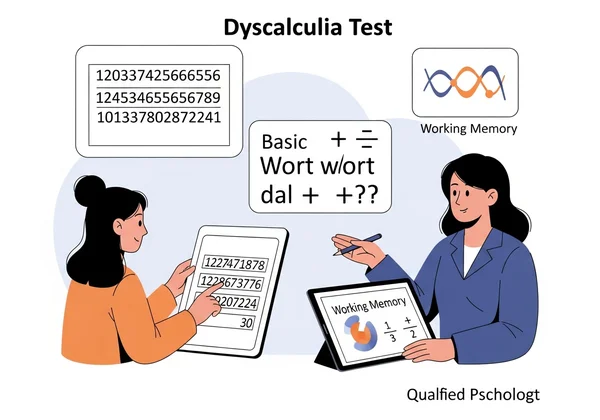
Cognitive Skills: Testing areas like working memory (holding information in mind), processing speed, and visual-spatial skills.
Interpretation & Feedback: Understanding the Results
After the testing is complete, the specialist will score the assessments and analyze all the information gathered. They will write a comprehensive report that explains the findings in detail.
You will then have a feedback session where the professional will:
- Explain the test results in plain language.
- State whether the results meet the criteria for a dyscalculia diagnosis (often based on standards like the DSM-5).
- Provide a written report with personalized recommendations for support, strategies, and accommodations.
This final report is an incredibly valuable tool for moving forward.
Preparing for Your Dyscalculia Evaluation
Being prepared can make the evaluation process smoother and more effective. A little organization beforehand allows the specialist to get the clearest possible picture of the situation, leading to a more accurate outcome.
Gathering Essential Information & Documents
Before your first appointment, try to collect relevant documents. Having this information ready can save time and help your assessor immensely. Consider creating a folder with:
- School Reports: Past report cards, especially those with comments on math performance.
- Standardized Test Scores: Any state or school-wide testing results.
- Teacher Notes: Emails or notes from teachers describing their observations.
- Personal Notes: A list of specific examples of math struggles you or your child have experienced.
- Online Screening Report:** Results from a preliminary dyscalculia test.
- Previous Evaluations: Any past reports from other specialists.
Discussing Costs & Insurance Coverage
Professional assessments can be expensive, and it's important to be prepared financially. Before committing to an evaluation, ask the provider’s office about:
- Total Cost: Get a clear estimate of the full cost of the assessment, from consultation to the final report.
- Payment Plans: Ask if they offer options to pay in installments.
- Insurance: Check directly with your insurance provider to see if they cover "psycho-educational testing" for learning disabilities. Coverage can vary widely, so getting a clear answer is crucial.
Advocating for Yourself or Your Child
You are the expert on your own experiences or your child's struggles. During the process, don't be afraid to speak up.
- Ask Questions: If you don't understand a term or a part of the process, ask for clarification.
- Share Everything: Even small details you think might be irrelevant could be an important piece of the puzzle.
- Ensure a Good Fit: Make sure you or your child feel comfortable with the professional. A positive, supportive relationship is key to a successful evaluation.
The Role of an Educational Psychologist in Dyscalculia Evaluation
While several types of professionals can diagnose dyscalculia, educational psychologists are uniquely positioned to help, particularly for children and students. Their entire field is dedicated to the science of learning.
Expertise in Learning Differences
An educational psychologist doesn’t just look at whether someone can do math problems. They look at the why behind the struggle. Their expertise allows them to:
- Differentiate Between Issues: Experts distinguish dyscalculia from similar challenges. These include math anxiety, teaching gaps, or co-occurring conditions like ADHD that impact math skills.
- Identify Strengths: A good evaluation also highlights a person's cognitive strengths, which can be used to develop effective learning strategies.
- Understand the Educational Context: They know the school system and can make recommendations that are practical and can be implemented in a classroom setting.
Beyond Diagnosis: Recommendations for Support
Perhaps the most important part of an educational psychologist's role is what comes after the diagnosis. They don't just give you a label; they give you a plan. Their final report will include specific, actionable recommendations, such as:
-
Specialized Instruction: Recommending teaching methods that are proven to work for individuals with dyscalculia.
-
Accommodations: Suggesting tools and adjustments for school or work, like using a calculator, having extra time on tests, or using graph paper to align numbers.
-
Strategies for Home: Providing parents with concrete ways to support their child's learning outside of school.

Next Steps After Your Dyscalculia Test
Moving from initial curiosity to a formal diagnosis can feel overwhelming. By understanding this process, you're already taking control. Start small: our free test gives you objective insights to discuss with professionals.
Take our free dyscalculia screening test and begin your personalized journey to richer math learning.**
Frequently Asked Questions About Dyscalculia Diagnosis
Dyscalculia Test FAQs: Diagnosis & Screening Differences
How to get tested for dyscalculia?
To get tested, you should seek a formal evaluation from a qualified professional, such as an an educational psychologist, clinical psychologist, or neuropsychologist. The first step is often to find a local specialist or clinic that has experience with learning disabilities and schedule an initial consultation.
Is there a test for dyscalculia that's free?
While a formal diagnostic assessment from a psychologist is not free, you can start with a free online screening tool. A screening can help you identify if you or your child have traits associated with dyscalculia. For a helpful starting point, you can take our free dyscalculia test for immediate insights.
How do you test for dyscalculia in adults?
Testing for dyscalculia in adults is similar to testing in children. It involves a comprehensive assessment with a qualified psychologist. The process includes an in-depth interview about your educational, professional, and personal history with math, followed by a series of tests that evaluate number sense, calculation skills, memory, and reasoning.
Do I have dyscalculia or am I just bad at math?
Many people feel they are "bad at math," but dyscalculia is different. It is a persistent, neurodevelopmental learning difference that makes processing numbers and math concepts unusually difficult, despite average intelligence and instruction. If your struggles with math are severe, have been present since childhood, and impact your daily life, it may be more than just being "bad at math."
What's the difference between dyscalculia screening and diagnosis?
A screening is a brief tool that identifies potential risk or signs of dyscalculia. It gives you an indication of whether further investigation is needed. A diagnosis is a comprehensive evaluation conducted by a qualified professional that can formally identify dyscalculia, explain your specific learning profile, and provide a basis for official accommodations and support.