Dyslexia, Dysgraphia, and Dyscalculia: Differences, Overlap, and Next Steps
Dyslexia, dysgraphia, and dyscalculia are learning differences that can affect reading, writing, and math in different ways. They are often discussed together because they can appear in the same child, teen, or adult, and one difficulty can make another harder to notice. A child who struggles with word problems may have a reading need, a math need, an attention need, or a mix of all three. An adult who avoids forms, budgets, or written tasks may have spent years compensating. If math is part of the concern, a free math learning screening tool can be a gentle first step for reflection, while professional evaluation remains the right path for formal educational decisions.

Dyslexia, Dysgraphia, and Dyscalculia Are Examples of Specific Learning Differences
The three terms describe different academic skill areas. Dyslexia mainly affects reading-related skills, dysgraphia affects written expression and the mechanics of writing, and dyscalculia affects number sense and math learning. They are not signs of laziness, low intelligence, or poor parenting. They describe patterns in how a person processes language, symbols, movement, memory, attention, or quantity.
In school settings, these concerns may fall under broader categories such as specific learning disability or specific learning disorder, depending on the professional, legal, or regional framework being used. Families may also see related terms in IEP or 504 discussions. The practical question is less about memorizing labels and more about asking, "Which skill is breaking down, and what support would make the task clearer?"
For example, a student may read fluently but avoid handwriting because letters are slow and tiring to form. Another may write neat sentences but cannot remember multiplication facts or estimate quantities. A third may understand math when it is read aloud but fail worksheet word problems because decoding the instructions takes all their energy. Each pattern points toward a different support plan.
The Core Difference: Reading, Writing, and Number Sense
Here is a simple way to separate the three:
| Learning difference | Main academic area | Common everyday signs | Support usually focuses on |
|---|---|---|---|
| Dyslexia | Reading and spelling | Slow decoding, poor reading fluency, spelling that does not match spoken knowledge | Structured literacy, phonics, audiobooks, extra reading time |
| Dysgraphia | Writing and written output | Painful or slow handwriting, uneven spacing, difficulty organizing ideas on paper | Keyboarding, speech-to-text, graphic organizers, reduced copying |
| Dyscalculia | Math and number sense | Trouble estimating, comparing quantities, remembering math facts, reading clocks or handling money | Visual models, number lines, manipulatives, step-by-step math routines |

Dyslexia can affect math when reading is required. Word problems, written instructions, and math vocabulary can turn a number task into a language task. Dysgraphia can affect math when a student understands the concept but lines up numbers incorrectly, copies symbols inaccurately, or loses place on the page. Dyscalculia is different because the central challenge is number meaning itself: quantity, magnitude, order, symbols, operations, or math facts may not become automatic.
That distinction matters. If the main barrier is reading, more calculation drills may miss the point. If the main barrier is handwriting, a student may need an alternate way to show knowledge. If the main barrier is number sense, the learner may need concrete math representations long after classmates have moved to abstract symbols.
Why They Often Overlap
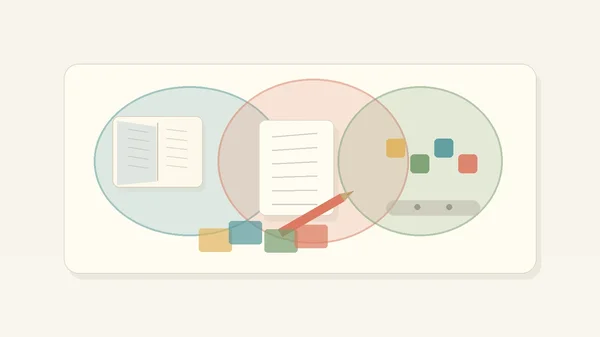
It is possible to have dyslexia, dysgraphia, and dyscalculia together. It is also possible to have one and appear to have another because school tasks rarely isolate one skill. Reading, writing, attention, working memory, language, fine motor control, and math reasoning often work at the same time.
Overlap can happen in several ways:
- A shared cognitive demand, such as working memory, makes multi-step tasks harder across subjects.
- A reading difficulty makes math instructions, word problems, and vocabulary harder to access.
- A writing difficulty makes it hard to record work, align numbers, or complete written assignments quickly.
- Math anxiety grows after repeated failure, which can make true skill patterns harder to see.
- ADHD, dyspraxia, speech-language needs, or processing-speed differences may add another layer.
This is why a single classroom observation rarely tells the whole story. A student who freezes during a timed math quiz may be struggling with number facts, speed pressure, handwriting, anxiety, attention, or all of those at once. The most useful next step is to collect patterns across settings rather than decide from one frustrating moment.
Dyslexia, Dysgraphia, Dyscalculia, Dyspraxia, and ADHD
Searches for dyslexia dyscalculia dysgraphia and ADHD often come from families who notice a broad learning profile instead of one neat concern. ADHD can affect planning, focus, impulsivity, task completion, and working memory. It does not automatically explain reading, writing, or math differences, but it can make each one more visible.
Dyspraxia is different again. It is commonly associated with motor planning and coordination. In school, that may show up as clumsiness, slow handwriting, difficulty with scissors or sports, trouble organizing materials, or fatigue during physical tasks. When people talk about the "four D's" of learning disabilities, they usually mean dyslexia, dysgraphia, dyscalculia, and dyspraxia. The phrase is informal, but it is useful because it reminds parents and educators to look beyond reading alone.
The safest way to think about these terms is as clues, not conclusions. If a child has messy handwriting, that could point toward dysgraphia, dyspraxia, low muscle tone, weak instruction, stress, vision issues, or a combination. If an adult struggles with budgeting, that could involve dyscalculia, attention, anxiety, limited practice, or trauma around math. Labels can guide questions, but the support plan should be based on observed needs.
A Practical Observation Checklist for Parents and Adults
Use this checklist to notice patterns before a school meeting, tutoring session, or professional assessment. It is not a formal evaluation, and it should not be used to label anyone. It simply helps you organize what you are seeing.
For reading, look for:
- Slow or effortful reading compared with listening comprehension.
- Guessing words from shape or context.
- Avoiding reading aloud.
- Spelling that remains inconsistent despite practice.
- Losing meaning because decoding takes too much effort.
For writing, look for:
- Handwriting that is unusually slow, painful, cramped, or hard to read.
- Uneven spacing, letter size, margins, or alignment.
- Strong spoken ideas but short or disorganized written responses.
- Trouble copying from the board or from another page.
- Fatigue during worksheets, note taking, or written tests.
For math, look for:
- Difficulty comparing quantities or estimating.
- Confusing math symbols or operation signs.
- Persistent trouble with math facts despite practice.
- Losing track while counting, measuring, reading clocks, or handling money.
- Difficulty lining up numbers, understanding place value, or following multi-step procedures.

If math signs are central, the site also offers dyscalculia learning resources that can help families explore number-sense challenges in a low-pressure way. The goal is not to replace a school or clinical assessment. It is to help you bring clearer examples to the people who can evaluate and support the learner.
What To Do If Your Child Has Signs of Several Learning Differences
When several signs fit, start with documentation. Write down specific examples: the assignment, what was hard, what helped, how long it took, and whether the difficulty appeared in reading, writing, math, attention, or motor output. Specific examples are more useful than broad statements like "math is impossible" or "writing is bad."
Next, compare performance across formats. Can your child explain an answer orally but not write it? Can they solve a math problem when you read it aloud? Can they understand a story when listening but not when reading independently? Can they do mental math but lose accuracy when copying steps? These comparisons often reveal whether the barrier is the concept, the language, the written output, the speed demand, or the task format.
Then talk with the school or a qualified professional. In the United States, families may hear about IEPs, Section 504 plans, school evaluations, or state-specific guidance. If you are searching for TEA dyslexia dysgraphia and dyscalculia in the IEP, the important point is to ask what evidence the team needs, which academic areas will be reviewed, and how supports will be matched to observed needs. This article is educational, not legal advice, and school processes vary by location.
Finally, reduce pressure while the picture becomes clearer. Use audiobooks for reading access, keyboarding or speech-to-text for written output, and visual math tools for number sense. These supports do not give a learner an unfair advantage. They can make the task measure the intended skill instead of measuring every barrier at once.
How Support Changes When the Main Barrier Is Different
Support works best when it matches the barrier. A learner with dyslexia may need structured literacy instruction, repeated practice with sound-symbol patterns, accessible text, and time to process written language. A learner with dysgraphia may need explicit handwriting support, reduced copying, keyboarding, speech-to-text, or outlines that separate idea generation from transcription. A learner with dyscalculia may need concrete number models, visual representations, number lines, place-value tools, and repeated practice that builds meaning before speed.
When overlap is present, supports can be layered. A student working on math word problems might receive text read aloud, a visual model, graph paper for alignment, and extra time. An adult managing finances might use calendar reminders, calculator supports, written templates, and visual budgeting categories. The support is not about lowering expectations. It is about removing unnecessary barriers so the person can show what they understand and build skills with less confusion.
Progress may be uneven. Reading may improve faster than spelling. Math concepts may grow while fact recall remains slow. Handwriting may become legible but still tiring. That uneven profile is common, and it is one reason compassionate, flexible support matters.
A Careful Next Step If Several Signs Fit
If dyslexia, dysgraphia, and dyscalculia all seem possible, the best next step is not to rush toward one label. Start by naming the tasks that are hardest, gathering examples, and asking what changes make performance better. A pattern that improves when text is read aloud may point in a different direction from a pattern that improves when numbers are shown on a number line.
For math-specific concerns, you can also explore a gentle first-step screening option to organize observations before discussing next steps with a school team, tutor, educational psychologist, physician, or other qualified professional. Screening information is only one piece of the picture. A complete support plan should consider classroom data, developmental history, strengths, emotional wellbeing, and the learner's own experience.
Most importantly, keep the language humane. A person can struggle with reading, writing, numbers, coordination, or attention and still be bright, creative, persistent, and capable. The purpose of understanding these learning differences is not to limit someone. It is to make the hidden barriers visible enough to support them well.
FAQ
What are the four D's of learning disabilities?
The informal "four D's" usually refers to dyslexia, dysgraphia, dyscalculia, and dyspraxia. Dyslexia affects reading and spelling, dysgraphia affects writing and written output, dyscalculia affects number sense and math, and dyspraxia affects motor planning and coordination. The phrase is a shortcut, not a formal assessment category.
What's the difference between dyslexia, dysgraphia, and dyscalculia?
Dyslexia is mainly connected to reading, decoding, fluency, and spelling. Dysgraphia is mainly connected to handwriting, written expression, spacing, and getting ideas onto paper. Dyscalculia is mainly connected to number sense, math facts, quantity, symbols, and mathematical reasoning.
How rare is it to have dyslexia, dysgraphia, and dyscalculia?
Having all three is less common than having one learning difference, but overlap is not unusual. Exact rates vary because studies, age groups, and evaluation methods differ. If several areas are affected, it is better to document the pattern carefully than to assume one label explains everything.
Can dyslexia, dysgraphia, dyscalculia, and ADHD occur together?
Yes, they can occur together. ADHD may affect attention, working memory, planning, and task completion, which can make reading, writing, and math challenges more noticeable. A broad evaluation can help separate attention-related barriers from skill-specific learning needs.
Is dyscalculia just dyslexia with numbers?
No. "Dyslexia with numbers" is a common nickname, but dyscalculia is not simply reading difficulty applied to math. Dyscalculia involves number sense, quantity, magnitude, math symbols, and calculation patterns. Reading difficulty can affect math word problems, but that is not the same as a core math learning difference.
Which president was dyslexic?
Public claims about historical dyslexia can be difficult to verify, especially when a person lived before modern evaluation methods. Some public figures have discussed reading difficulties or have been described by biographers as having dyslexia-like traits, but the more useful takeaway is that reading struggles do not define a person's intelligence, leadership, or potential.
Can dyslexia, dysgraphia, and dyscalculia be fixed?
People can make meaningful progress with the right instruction, accommodations, tools, and emotional support, but these learning differences are usually managed rather than simply "fixed." Support should focus on skill-building, access, confidence, and practical strategies that fit the learner's profile.