Dyslexia With Numbers: What It Is, What It's Called, and What to Do About It
If math has always felt like a foreign language — if numbers seem to rearrange themselves, basic calculations take forever, or telling time on an analog clock still feels impossible — you are not alone. Many people search for "dyslexia with numbers" to describe exactly this experience. The condition has a name: dyscalculia. And understanding it is the first step toward getting the right support. This guide explains what dyscalculia is, how it differs from dyslexia, what the signs look like in children and adults, and what you can do about it. If you want to start exploring whether number-related difficulties might apply to you or your child, a free dyscalculia screening can offer a helpful starting point.

What Is Dyslexia With Numbers Called?
The condition commonly described as "dyslexia with numbers" is officially called dyscalculia (pronounced dis-kal-KYOO-lee-uh). While people often call it "math dyslexia" or "number dyslexia," dyscalculia is a distinct learning difference with its own diagnostic criteria, neurological basis, and set of challenges.
Dyscalculia is a specific learning disorder that affects a person's ability to understand numbers, learn math facts, perform calculations, and reason mathematically. It is recognized by major medical and psychological organizations, including the DSM-5, which classifies it under "Specific Learning Disorder with impairment in mathematics."
Key facts about dyscalculia:
- It affects an estimated 3–7% of the population worldwide
- It is not related to intelligence — people with dyscalculia can excel in reading, writing, creative thinking, and many other areas
- It is a lifelong condition, but with the right strategies, its impact can be significantly reduced
- It can co-occur with dyslexia, ADHD, and other learning differences
Dyscalculia is not about being "bad at math." It reflects genuine differences in how the brain processes numerical information — and it deserves proper recognition and support.
How Is Dyscalculia Different From Dyslexia?
Since "dyslexia with numbers" is such a common search term, it is worth explaining exactly how these two conditions relate — and where they diverge.
| Feature | Dyslexia | Dyscalculia |
|---|---|---|
| Primary area affected | Reading, spelling, language processing | Numbers, math concepts, calculations |
| Core difficulty | Decoding written language, phonological awareness | Number sense, numerical magnitude, arithmetic |
| Number reversals | May reverse letters and occasionally numbers (visual-spatial) | May confuse numbers due to poor understanding of place value |
| Math word problems | Struggles because of reading comprehension issues | Struggles because of mathematical reasoning issues |
| Time telling | May struggle due to sequencing difficulties | Struggles specifically with analog clocks and time estimation |
| Prevalence | ~5–10% of the population | ~3–7% of the population |
| Can co-occur? | Yes — approximately 60% of people with dyscalculia also have dyslexia | Yes |
The key distinction: Dyslexia affects how the brain processes language. Dyscalculia affects how the brain processes numbers. A person can have one, the other, or both.
If you experience difficulty with numbers but read fluently, dyscalculia is the more likely explanation. If you struggle with both reading and math, it is worth exploring whether both conditions are present.
Signs of Dyscalculia in Children
Dyscalculia often becomes noticeable when children start learning math in school. However, some signs appear even earlier. Here is what to watch for at different ages.
Early Signs (Ages 4–7)
- Difficulty learning to count or frequently losing track while counting
- Trouble connecting a number symbol (like "5") with the actual quantity it represents
- Relying on fingers to count long after peers have moved on
- Struggling with concepts like "more," "less," "bigger," and "smaller"
- Difficulty recognizing patterns or sorting objects by size or shape
School-Age Signs (Ages 7–12)
- Persistent difficulty memorizing basic math facts (addition, subtraction, multiplication tables)
- Confusing mathematical operation signs (+, −, ×, ÷)
- Trouble understanding place value (mixing up tens, hundreds, thousands)
- Difficulty telling time on an analog clock
- Struggling with word problems — not because of the reading, but because of the math
- Avoiding math homework or showing strong emotional reactions (anxiety, frustration, tears) when faced with math tasks
- Counting on fingers for calculations that classmates do mentally
Older Students (Ages 12+)
- Difficulty with fractions, percentages, and ratios
- Struggling to estimate costs, distances, or quantities
- Trouble reading charts and graphs
- Avoiding subjects or activities that involve math
- Low confidence in academic ability despite strong performance in non-math subjects
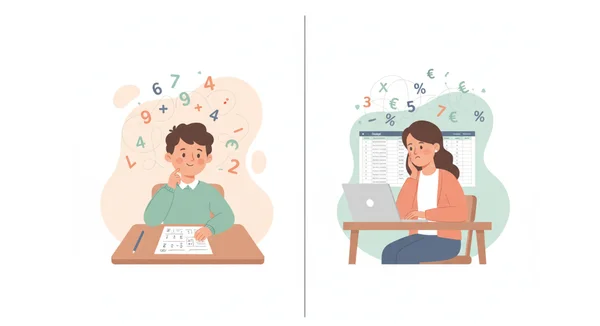
If your child shows several of these signs consistently, the difficulty is likely not laziness or lack of effort. It may be worth exploring further with a dyscalculia screening tool or a professional evaluation.
Signs of Dyscalculia in Adults
Many adults with dyscalculia were never diagnosed as children. They may have spent years believing they were simply "not a math person." Recognizing the signs in adulthood can bring tremendous clarity and relief.
Common Signs in Adults
- Basic arithmetic remains challenging. You still reach for a calculator for simple addition or subtraction. Mental math feels nearly impossible.
- Estimating is difficult. Judging how much time a task will take, how far away something is, or how much food to cook for a group feels like guesswork.
- Money management is stressful. Budgeting, calculating tips, splitting bills, reading financial statements, or understanding interest rates causes anxiety.
- Telling time is unreliable. Analog clocks remain confusing. You may frequently misjudge how much time has passed.
- Phone numbers and dates are hard to remember. Numerical sequences do not stick in memory the way words or names do.
- Math anxiety persists. Situations involving numbers — at work, in stores, during meetings — trigger genuine stress or avoidance.
- Navigation by numbers is challenging. Reading bus schedules, following numbered directions, or using measurement-based recipes feels overwhelming.
Why It Matters for Adults
Undiagnosed dyscalculia in adults does not just affect math class — it impacts careers, finances, daily planning, and self-esteem. Recognizing it as a learning difference (rather than a personal failure) is the first step toward finding strategies that actually help.
Can You Have Dyslexia With Numbers Only?
Yes. It is entirely possible to struggle with numbers while having no difficulty with reading or writing. This is precisely what distinguishes dyscalculia from dyslexia.
Some people experience challenges with both numbers and letters. When that happens, they may have co-occurring dyscalculia and dyslexia. But many people have dyscalculia alone — their reading and writing skills are strong, yet numbers remain persistently difficult.
Other related conditions worth knowing about:
- Dysgraphia — difficulty with handwriting and fine motor skills related to writing
- ADHD — attention difficulties that can compound math challenges but are a separate condition
- Math anxiety — emotional distress around math that can exist on its own or alongside dyscalculia
If your struggles are specifically with numbers, calculations, and mathematical reasoning — but reading, writing, and verbal communication feel comfortable — dyscalculia is the most accurate description.
How Is Dyscalculia Diagnosed?
A formal dyscalculia diagnosis requires a comprehensive evaluation by a qualified professional. Here is what the process typically involves.
Who Performs the Evaluation?
- Educational psychologists — most commonly conduct dyscalculia assessments
- Clinical psychologists or neuropsychologists — for more complex cases or when multiple conditions are suspected
- School psychologists — may conduct initial screenings within the school system
What the Evaluation Includes
- Clinical interview — A detailed conversation about academic history, family history of learning differences, and current challenges
- Cognitive assessment — Tests measuring general reasoning, working memory, and processing speed
- Math-specific testing — Standardized tasks evaluating number sense, calculation skills, math fluency, and problem-solving
- Ruling out other factors — The evaluator checks whether anxiety, vision problems, hearing issues, or inadequate instruction might explain the difficulties
- Written report — A comprehensive summary of findings, diagnosis, and specific recommendations
Should You Start With a Screening?
A formal evaluation can be time-consuming and expensive. Many people find it helpful to start with an online screening to determine whether a full evaluation is warranted. The dyscalculia screening at DyscalculiaTest.com is designed by educational psychologists and provides an immediate assessment of your number processing patterns — along with an optional AI-powered personalized report that identifies specific strengths and challenges.
Strategies and Support for Living With Dyscalculia
Dyscalculia is a lifelong condition, but it does not have to limit your potential. With the right strategies, tools, and support, people with dyscalculia lead fully successful lives.
For Children
- Multisensory learning: Use physical objects (blocks, beads, measuring cups) to make abstract math concepts concrete
- Visual aids: Number lines, charts, color-coded place value systems, and graphic organizers
- Repetition without shame: Practice math facts using games and apps rather than timed drills that increase anxiety
- One-on-one tutoring: Specialized math tutoring tailored to the child's specific areas of difficulty
- Accommodations at school: Extended time on math tests, the use of calculators, and modified assignments
For Adults
-
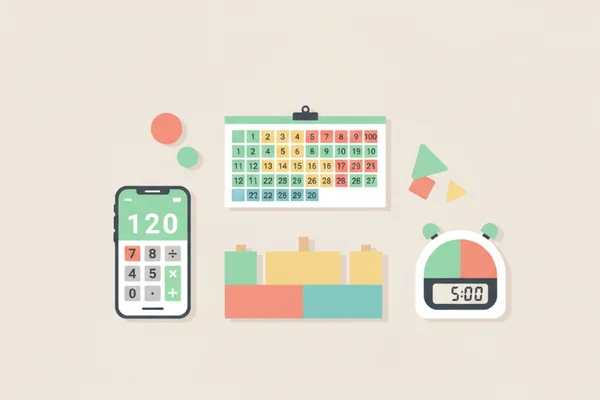
Assistive technology: Calculator apps, budgeting software, spreadsheet templates, and voice-activated math tools
-
Chunking information: Break numbers into smaller, manageable groups (e.g., phone numbers as 3-3-4 patterns)
-
Visual timelines: Use digital calendars with visual reminders rather than relying on mental time estimation
-
Financial tools: Automatic bill payments, budgeting apps that visualize spending, and simplified financial dashboards
-
Self-compassion: Recognizing dyscalculia as a neurological difference — not a character flaw — is one of the most powerful strategies of all
Your Next Step Toward Clarity
If this article has helped you put a name to something you or your child has been experiencing, that recognition alone is meaningful. Dyscalculia is real, it is common, and it is nothing to be ashamed of.
Whether you are a parent watching your child struggle, an adult who has always wondered why numbers feel so hard, or an educator looking for answers — the path forward starts with understanding.
This content is for educational purposes only. It is not a substitute for professional diagnosis or treatment. If you suspect dyscalculia, consult a qualified educational psychologist or neuropsychologist for a formal evaluation.
Ready to explore further? Take the free dyscalculia screening at DyscalculiaTest.com — it is private, immediate, and designed by experts to help you understand your unique relationship with numbers.
Frequently Asked Questions
What is dyslexia with numbers called?
The condition commonly described as "dyslexia with numbers" is called dyscalculia. It is a specific learning disorder that affects a person's ability to understand numbers, perform calculations, and reason mathematically. It is recognized in the DSM-5 and is distinct from dyslexia, which primarily affects reading and language processing.
Can you have dyslexia with numbers only?
Yes. Dyscalculia can exist independently of dyslexia. Many people with dyscalculia read and write fluently but struggle significantly with numbers, calculations, and mathematical concepts. However, approximately 60% of people with dyscalculia also have co-occurring dyslexia.
What are the main signs of dyscalculia?
Common signs include difficulty with basic arithmetic, poor number sense, trouble memorizing math facts (like multiplication tables), difficulty telling time on analog clocks, challenges with money management and estimation, confusion with math symbols, and persistent math anxiety — despite effort and instruction.
How is dyscalculia diagnosed?
Dyscalculia is diagnosed through a comprehensive evaluation conducted by an educational psychologist, clinical psychologist, or neuropsychologist. The assessment includes cognitive testing, math-specific evaluations, a clinical interview about academic history, and ruling out other potential causes of math difficulty.
Is dyscalculia the same as being bad at math?
No. Dyscalculia is a neurological learning difference — not a reflection of effort, intelligence, or character. People with dyscalculia may struggle with numbers despite strong abilities in other areas. The difficulty stems from how the brain processes numerical information, not from a lack of trying.
Can adults be diagnosed with dyscalculia?
Yes. Many adults discover they have dyscalculia later in life, often after years of believing they were simply "not math people." An evaluation by a qualified professional can provide a formal diagnosis at any age, along with specific strategies for managing daily challenges.
What is the difference between dyscalculia and math anxiety?
Math anxiety is an emotional response — feelings of stress, fear, or avoidance when faced with math. Dyscalculia is a neurological condition that impairs the brain's ability to process numbers. A person can have math anxiety without dyscalculia, dyscalculia without significant anxiety, or both conditions together.