How Our AI Dyscalculia Report Works: Cognitive Pattern Analysis
Have you ever taken an online quiz, received a simple score, and felt there must be more to the story? When it comes to understanding a complex learning difference like dyscalculia, a basic score only scratches the surface. It can tell you if you have certain tendencies, but it doesn't explain why.
This is where true insight begins. At DyscalculiaTest.com, our free screening tool is enhanced with an optional AI-powered analysis that transforms your answers into a detailed cognitive profile. This article will demystify our AI report, explaining how it uncovers the deeper cognitive patterns behind your experiences with math. If you're ready to understand the "why" behind your math challenges, this is the place to start. For a firsthand look, take the free test on our homepage.
Beyond Basic Scores: How AI Transforms Test Data
A standard test simply tallies your correct and incorrect responses to produce a score. Our AI system, however, treats each answer as valuable data. It examines not just what you answered, but the patterns across all your responses to create a richer, more detailed picture of your cognitive profile.
This transformation is what sets our analysis apart. Instead of a single number, you receive insights into the specific cognitive functions that influence your relationship with mathematics. It’s the difference between knowing you have a fever and understanding what’s causing it. Our goal is to empower you with knowledge, providing a clear and actionable understanding of your unique cognitive landscape.
Educational Psychology Meets Machine Learning
Our AI report isn't magic—it's the result of powerful collaboration. Educational psychology and math experts designed questions targeting specific cognitive markers of dyscalculia. We then apply machine learning (a type of AI) to this expert framework.
The AI has been trained on vast amounts of anonymized data, learning to recognize complex patterns that a human might miss. It connects your responses to established research in cognitive science, translating your answers into the language of educational psychology. This blend of human expertise and AI precision ensures your report is both scientifically grounded and deeply personalized.
From Multiple Choice to Cognitive Maps
As you complete our dyscalculia screening, the system looks beyond simple A, B, C, or D responses. It analyzes relationships between your answers across different categories. For instance, it might notice you consistently struggle with quantity estimation questions but excel at pattern recognition tasks.
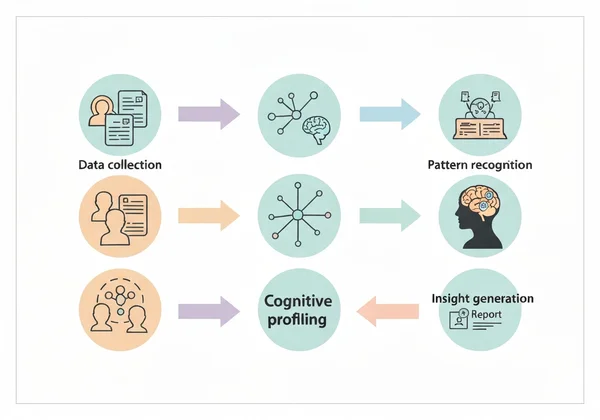
This process involves several steps:
- Data Collection: Your anonymous answers from the test are gathered.
- Pattern Recognition: The AI algorithm sifts through this data, identifying recurring themes and connections. It looks for signatures related to number sense, working memory, and spatial reasoning.
- Cognitive Profiling: Based on these patterns, the system builds a profile of your cognitive strengths and challenges as they relate to math.
- Insight Generation: Finally, the AI translates this technical profile into clear, easy-to-understand language.
The result is a detailed map that charts the unique terrain of your mathematical mind. To see how this process can illuminate your own experience, start your test today.
Unpacking Your Personal Cognitive Profile
Your personalized AI report gives you specific, meaningful insights. It moves away from generalities and focuses on the core cognitive areas crucial for mathematical ability. Understanding these components helps you pinpoint where challenges may arise and where you might have hidden strengths. Let's explore the key areas your report analyzes.
Number Sense Processing
Number sense is an intuitive feel for numbers—understanding their quantity, relationships, and how they can be manipulated. For many individuals with dyscalculia, this is a core area of difficulty. It’s not about an inability to count; it’s about the number "5" not feeling inherently larger than "2."
Our AI analysis examines your responses for patterns indicating challenges in number sense. This might manifest as:
- Difficulty estimating quantities.
- Trouble comparing numbers quickly.
- A weak understanding of place value.
By identifying these specific patterns, the report helps you understand if the foundation of your math struggles lies in this fundamental area.
Working Memory Patterns
Do you ever forget the first number in a multi-step problem by the time you reach the end? This is a common experience related to working memory, which is like your brain's temporary notepad for holding and manipulating information.
Math heavily relies on working memory to remember steps, carry numbers, or track variables. Our AI report analyzes your performance on questions that tax your working memory. If it detects a pattern of difficulty, it can explain why complex problems feel so overwhelming. This insight is crucial for developing strategies, like writing down every step, to support your working memory.
Visual-Spatial Reasoning in Math
Mathematics isn't just about abstract numbers; it's also highly visual. Think about geometry, graphs, and even aligning numbers in a column for subtraction. Visual-spatial reasoning is the ability to mentally picture and manipulate objects.
This cognitive skill can be both a challenge and a strength. Some people with dyscalculia struggle to read analog clocks or interpret maps. Others may have strong visual-spatial skills that can be leveraged, for instance, by using diagrams to understand abstract concepts. Our AI analysis helps identify your specific profile in this area. Ready to uncover your profile? Get started with our free dyscalculia test.
Making Sense of Your Results: Practical Applications
Receiving a detailed cognitive profile is insightful, but its true power lies in its practical application. The goal of our AI report is not just to inform you but to empower you with a personalized roadmap and concrete suggestions tailored to your unique cognitive patterns.
Translating Analysis into Learning Strategies
Once your cognitive profile is generated, the AI system cross-references your specific patterns of strengths and weaknesses with a database of evidence-based learning strategies. This is where personalization becomes truly transformative.
For example:
- If your report highlights challenges with working memory, it might suggest using checklists or breaking down problems into smaller steps.
- If a weakness in number sense is identified, it might recommend using physical manipulatives (like blocks or coins) to build a more concrete understanding of quantity.
- If you show strong visual-spatial skills, the report may suggest leveraging this strength by using graphs and diagrams to solve problems.
These are not generic tips; they are targeted recommendations designed to work with your brain, not against it.
Personalized Tool Recommendations
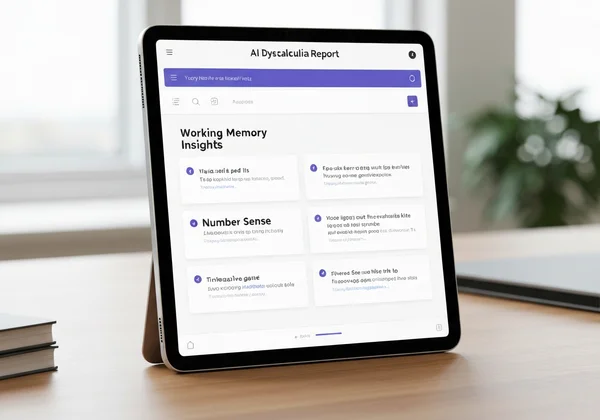
The AI report helps cut through the noise of finding the right learning tools by suggesting specific apps or software that align with your cognitive profile. For instance, someone with visual-spatial challenges might receive a recommendation for a graphing calculator app that visualizes equations. By connecting your personal data to relevant resources, the report provides a practical starting point for building your support toolkit. Discover which tools might work for you by taking our online dyscalculia screening.
Your Roadmap to Mathematical Confidence
Our AI report helps you understand exactly how your brain processes mathematical information, creating a personalized roadmap to address your specific challenges. It moves beyond a simple "pass" or "fail" to give you a deep, actionable understanding of your own cognitive patterns.
With this knowledge, you can turn frustration into focused action. Our report provides specific strategies based on your unique cognitive profile, helping you build confidence in math. It helps parents, adults, and educators move from confusion to constructive action.
Are you ready to go beyond the score and discover your unique cognitive roadmap? Your journey to clarity starts here. Take our free dyscalculia test today and unlock your personalized AI analysis report.

Your Questions Answered
How accurate is the AI analysis compared to a professional evaluation?
Our free test and AI analysis are a powerful screening tool, not a formal diagnosis. They accurately identify signs and cognitive patterns associated with dyscalculia and provide a strong indication of whether further assessment is needed. For a formal diagnosis, you should always consult a qualified professional, such as an educational psychologist.
What makes the AI report different from other online tests?
Many tests provide only a simple score. Our key differentiator is the personalized cognitive analysis. We don't just tell you if you show signs of dyscalculia; our report explains how these signs manifest in your cognitive profile. It breaks down your results into areas like number sense and working memory and provides tailored strategies, making the results far more actionable.
Is my data secure when I use the AI analysis?
Absolutely. We take your privacy and data security very seriously. All information you provide is anonymized and securely processed. The information you share to unlock the AI report is used solely to generate your personalized analysis and is never shared. To learn more, feel free to visit our site.