Number Dyslexia: What It Is, Signs to Watch, and How to Test (Is It Dyscalculia?)
Have you ever stood in front of a cash register, staring blankly as the numbers on the screen seem to dance or swap places? Or perhaps you dread splitting a dinner bill because simple percentages feel like advanced calculus. If numbers have always felt like a foreign language that everyone else speaks fluently, you are not alone.
Many people search for "number dyslexia" to describe this frustration. It is not just about being "bad at math." It is a specific way your brain processes quantitative information. This guide will clarify what is happening, help you identify common signs in adults and children, and explain how to screen for it.
If you suspect this impacts your daily life, understanding the symptoms is the first step. You might also consider taking a preliminary dyscalculia test to gain deeper insight into your specific learning profile.

What is "Number Dyslexia" Actually Called?
The term "number dyslexia" is widely used in casual conversation, but you won't find it in a medical textbook. Professionals and educators use the formal term: Dyscalculia.
It's Officially Known as Dyscalculia
While "dyslexia" specifically refers to difficulties with reading and language processing, Dyscalculia (pronounced dis-cal-cool-ee-ah) is a specific learning disability that affects a person's ability to understand, learn, and perform math and number-based operations.
Think of it this way: just as a dyslexic brain might struggle to decode the sounds of letters, a dyscalculic brain struggles to decode the value and logic of numbers. It is a neurodevelopmental difference, meaning it is related to how the brain is wired, not how smart you are.
Why It’s More Than Just "Bad at Math"
It is easy to dismiss these struggles as simply "hating math" or having a poor teacher in third grade. However, the difference lies in the concept of Number Sense.
Most people have an intuitive sense of quantity. If you see a group of three apples and a group of ten apples, you know which is larger without counting. People with number dyslexia often lack this innate sense. They may need to count on their fingers long after their peers have stopped, or they cannot estimate how long a 15-minute drive will take.
Common Symptoms: How to Spot Number Dyslexia
Because this condition is often misunderstood, many people go years—or even decades—without realizing why they struggle. The signs can look different depending on your age and life stage.
Signs in Adults (Money, Time, and Direction)
Adults often develop coping mechanisms to hide their difficulties, but the friction usually shows up in daily management tasks. Common indicators include:
- Money Management: Profound difficulty creating budgets, balancing a checkbook, or estimating the total cost of groceries before reaching the register.
- Time Blindness: Frequently running late because you cannot estimate how long tasks take, or struggling to read analog clocks.
- Directional Confusion: Getting lost easily, struggling to read maps, or constantly mixing up "left" and "right."
- Recall Issues: Inability to remember PINs, phone numbers, or game scores immediately after hearing them.
Signs in Children (School Challenges)
In children, "number dyslexia" often presents as a significant gap between their math skills and their performance in other subjects. You might notice:
- Reliance on finger counting for simple addition (e.g., 2 + 3).
- Difficulty recognizing written numbers (linking the symbol "4" to the concept of four items).
- Anxiety or avoidance when math homework appears.
- Trouble understanding math vocabulary like "greater than" or "less than."
The "Reading Numbers Backwards" Phenomenon
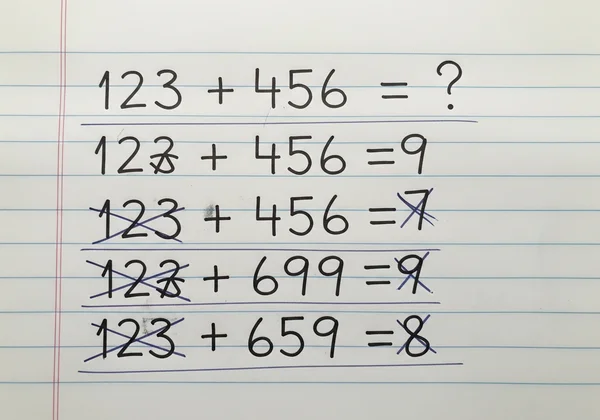
One of the most specific search terms we see is dyslexia numbers backwards. This refers to a visual-spatial issue where a person might read "53" as "35" or write numbers in reverse orientation (mirror writing).
While this can happen in standard dyslexia, it is also a hallmark of number dyslexia. The brain struggles to hold the sequence of digits in working memory. Consequently, the numbers may seem to jump, flip, or reverse on the page, making multi-step math problems nearly impossible to solve accurately.
Clarifying Confusions: Dyslexia, Math Anxiety, and Dyscalculia
Because the brain is complex, learning differences rarely exist in a vacuum. It is crucial to distinguish between three common, overlapping experiences.
Dyslexia vs. Dyscalculia: Words vs. Numbers
Are they the same thing? No.
- Dyslexia impacts language: reading, spelling, and phonological processing.
- Dyscalculia impacts quantity: counting, patterns, and arithmetic.
However, research suggests a high rate of comorbidity. This means if you have dyslexia, you are statistically more likely to also have dyscalculia, and vice versa. It is possible to struggle with both numbers and words, or to struggle exclusively with one.
Dyscalculia vs. Math Anxiety: Which Is It?
This is the most common confusion. Math Anxiety is an emotional reaction—a feeling of tension or fear that interferes with math performance. Dyscalculia is a cognitive difference in processing.
Here is a quick way to differentiate:
- If you can do the math perfectly when you are calm at home, but freeze up during a test, it might be Math Anxiety.
- If the concepts of quantity and logic remain confusing even when you are relaxed and supported, it is more likely Number Dyslexia (Dyscalculia).
Note: Years of undiagnosed dyscalculia almost always lead to math anxiety. It is very common to have both.
Identification & Screening: Taking the Next Step
Recognizing the symptoms is a relief for many. It puts a name to a lifelong struggle. But how do you confirm if your experiences align with the profile of number dyslexia?
The Mini-Checklist: Do These Sound Familiar?
Before seeking formal evaluations, ask yourself (or observe your child) regarding these frequent scenarios:
- The Tip Calculation: Do you rely entirely on your phone to calculate a 15% or 20% tip because mental estimation feels impossible?
- The "Left/Right" Pause: Do you have to physically check your hands (making an 'L' shape) to know which way to turn?
- The Analog Clock: Do you prefer digital clocks because "reading" a circular clock face takes too much mental energy?
- Number Permanence: Does a math fact (like 7x7=49) feel like new information every time you encounter it?
- Distance Estimation: Do you have no concept of how far "500 feet" actually is?
Why Screening Matters (Knowledge is Power)
Identifying number dyslexia is not about finding an excuse; it is about finding a roadmap. When you understand your brain's processing style, you can stop blaming yourself for being "lazy" or "not trying hard enough." You can start using tools and strategies that actually work for you.
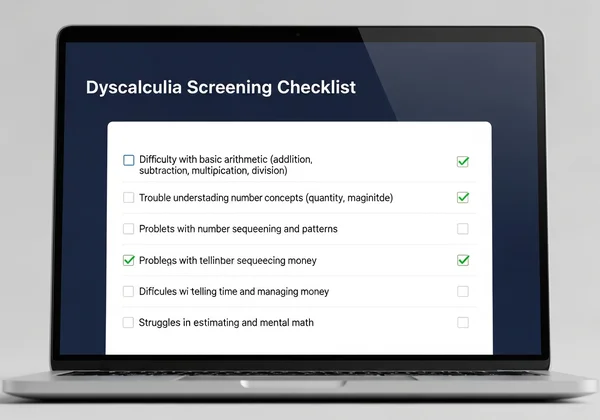
Try the Free Dyscalculia Screening Tool
If the checklist above resonated with you, the next logical step is to dig deeper. You don't need a doctor's referral to start exploring your cognitive profile.
We offer a comprehensive, education-based tool designed to help you identify potential traits of dyscalculia. It analyzes your responses to give you a clearer picture of your number sense strengths and weaknesses.
Explore our online dyscalculia test to receive a personalized report. It is free, private, and takes only a few minutes to complete.
Practical Strategies for Living with Number Dyslexia
Whether or not you have a formal diagnosis, you can improve your quality of life immediately by changing how you interact with numbers. The goal is not to "cure" the condition, but to manage it effectively.
Using Technology to Your Advantage
There is no shame in outsourcing the heavy lifting to computers. In the real world, mental math is rarely required.
- Tip Calculators: Use apps specifically for splitting bills.
- Voice Assistants: Ask Siri or Alexa to do conversions ("How many cups in a quart?") to avoid working memory overload.
- Digital Calendars: Use visual block scheduling and set multiple alarms to combat time blindness.
Visual Learning Techniques
Abstract numbers are the enemy. Make them concrete.
- Graph Paper: Use graph paper instead of lined paper to keep number columns straight during calculations.
- Color Coding: Use different colored highlighters for different place values (ones, tens, hundreds) or mathematical operations.
- Manipulatives: For children, using physical blocks or beads is often more effective than written worksheets.
Accommodations at Work or School
If number dyslexia impacts your performance, you may be entitled to accommodations.
- Extra Time: Requesting extended time on exams to allow for slower processing.
- Reference Sheets: Asking for access to multiplication tables or formula sheets during tasks.
- Calculator Use: Ensuring permission to use a calculator for all non-computational assessments.
Moving Forward: Embracing Your Unique Brain
Discovering that you have number dyslexia can be an emotional journey. You might feel relief, but also grief for the years you spent struggling. That is completely normal.
Remember, a difficulty with numbers does not equal a lack of intelligence. Many people with dyscalculia are brilliant artists, writers, leaders, and problem-solvers. Their brains simply prioritize different pathways.
By identifying the signs and using the right strategies, you can minimize the frustration. If you are ready to stop guessing and start understanding, take a moment to check your traits with this dyscalculia screening test. It is the first step toward making math—and life—a little less overwhelming.
Frequently Asked Questions
Can you be dyslexic with numbers but not words?
Yes. While they often occur together, it is entirely possible to have dyscalculia (difficulty with numbers) without having dyslexia (difficulty with words). They are distinct neurodevelopmental conditions.
Is number dyslexia genetic?
Research strongly suggests a genetic component. If a parent or sibling struggles with math learning disabilities, there is a higher likelihood that a child in the family will also experience number dyslexia.
Is number dyslexia a form of ADHD?
No, it is not a form of ADHD, but they are "neighbors." A significant percentage of people with ADHD also have dyscalculia. ADHD can also make math harder due to focus issues, even if the person understands the math concepts.
Is there a "cure" for number dyslexia?
There is no medical "cure" because it is a lifelong brain difference. However, it is highly manageable. With educational therapy, multisensory instruction, and accommodations, individuals can significantly improve their math skills and confidence.
How accurate are online number dyslexia tests?
Online tests are designed as screening tools, not diagnostic instruments. They are very accurate at identifying the signs and risk factors of number dyslexia, which helps you decide if you need to seek a formal evaluation from an educational psychologist.