What Is Disnumeracy? Understanding Number Blindness and Math Learning Differences
For many individuals, struggling with basic math concepts goes far beyond being bad at numbers. If you or your child look at a simple sequence of digits and feel an overwhelming wave of math anxiety, or if estimating quantities feels like guesswork, you might be encountering a specific numerical processing difference. This comprehensive guide unpacks the concept of disnumeracy—often described as "number blindness"—by exploring its core traits, distinguishing it from common spelling confusions, and highlighting how it connects to broader learning differences like dyscalculia. By providing a practical checklist of daily signs and evidence-based coping strategies, this framework helps you move from confusion to an empathetic, scientific understanding of your unique cognitive profile. Navigating these numerical challenges becomes much easier when you can access a free dyscalculia screening online to help clarify your initial observations and gather clear insights.

1. What Is Disnumeracy? (Defining the Core of Number Blindness)
Disnumeracy is a term used in educational psychology and cognitive science to describe a fundamental difficulty in understanding and processing numerical information. At its core, this learning difference affects an individual's innate "number sense"—the intuitive ability to understand, compare, and manipulate quantities.
The Cognitive Science Behind Your Number Sense
In a typical brain, processing a number happens almost instantly. When you see the digit "5," your brain automatically links that symbol to a specific quantity, such as five dots or five apples. However, when an individual experiences numerical processing challenges, this automatic link becomes disrupted. The brain must work much harder to translate abstract symbols into concrete meaning. Research suggests this difference relates to unique neural pathways in the parietal lobe, which is the specific region responsible for spatial and numerical estimation.
Why "Number Blindness" Is the Closest Comparison
To make this concept easier to understand, experts often compare disnumeracy to color blindness. A person with color blindness cannot intuitively distinguish between certain shades, requiring external clues to navigate their environment. Similarly, an individual with number blindness can see the digits perfectly well, but the underlying value of those digits does not register automatically. It is not an issue of general intelligence or effort. Instead, it represents a specific variation in how the brain visualizes and organizes mathematical data.
2. Dysmetria vs. Disnumeracy: Clarifying a Common Spelling and Concept Confusion
When searching for information about numerical difficulties online, many users accidentally mistype the term or encounter confusing medical jargon. The most frequent mix-up occurs between the words dysmetria and disnumeracy. While they sound remarkably similar, they belong to completely different fields of study and describe entirely unrelated human experiences.
To ensure you find the right support and information, it helps to look at how these two terms contrast across key areas:
| Feature | Dysmetria | Disnumeracy |
|---|---|---|
| Primary Domain | Neurological Motor Control | Cognitive Learning Difference |
| Brain Region Involved | Cerebellum (Coordination Center) | Parietal Lobe (Numerical Processing Center) |
| Core Symptom | Inability to judge distance or scale in physical movements (e.g., overshooting a target). | Inability to intuitively grasp numerical values, sizes, and mathematical patterns. |
| Common Indicator | Struggling with physical coordination, such as a finger-to-nose physical test. | Struggling with basic math concepts, estimating grocery costs, or reading clock faces. |
| Context | Often discussed alongside clinical terms like ataxia in medical environments. | Discussed alongside learning differences like dyscalculia in educational environments. |
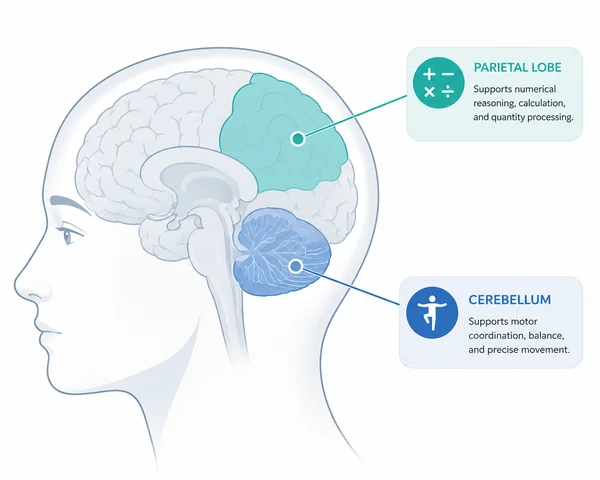
If you are reading this guide because you or a loved one experience persistent learning difficulties in maths, your primary focus is likely disnumeracy. Recognizing this distinction protects you from unnecessary medical worry and ensures you seek resources tailored to cognitive learning differences rather than motor coordination.
3. Recognizing the Patterns: Key Signs of Disnumeracy in Daily Life
Identifying number blindness requires looking past general exam scores and focusing on how an individual interacts with numbers in everyday settings. Because this condition alters foundational numerical processing, it patterns itself into noticeable behavioral signs.
Subitizing and Estimation: The Subtle Daily Hurdles
One of the clearest indicators of disnumeracy is a persistent challenge with a cognitive skill called subitizing. Subitizing is the ability to look at a small group of objects—like three coins on a table—and instantly know how many there are without counting them one by one. For someone with number blindness, even three objects must be counted individually. Estimation presents a similar hurdle. When asked to estimate whether a box weighs five pounds or fifty pounds, or whether a store checkout line has five people or twenty, an individual with this profile often finds it incredibly difficult to make an accurate guess.
How Number Blindness Impacts Daily Life and Routines
Mathematical reasoning difficulties do not stay confined to the classroom. In adulthood and homelessness or career routines, these challenges show up during standard daily routines:
- Time Management: Finding it difficult to estimate how much time has passed or struggling to read a classic analog clock face.
- Financial Tracking: Experiencing consistent confusion when calculating a restaurant tip, balancing a budget, or conceptualizing a total price during shopping.
- Spatial Navigation: Mixing up left from right, or struggling to read map distances and speedometers accurately.
Behavioral Signs in Adults vs. School-Aged Children
In children, look for a heavy reliance on finger-counting long after their peers have moved on, alongside severe distress during basic math homework. Adults, on the other hand, often develop complex coping mechanisms to avoid numbers entirely. An adult might consistently delegate financial tasks to a partner, experience severe math anxiety when put on the spot at work, or struggle to remember simple numerical codes, pin numbers, and dates.
4. Navigating Your Numerical Profile: A Safe Path to Self-Discovery
Discovering that your daily frustrations align with the signs of disnumeracy can feel both validating and overwhelming. The transition from noticing these patterns to finding answers does not have to cause additional stress or anxiety.
Organizing Your Thoughts through Structured Screening
When you are unsure where to begin, organizing your observations into a structured format can provide immense relief. Rather than viewing your math difficulties as a single, confusing obstacle, you can look at specific cognitive components. Gathering this information allows you to see exactly where your processing style varies. Many people find that taking an online dyscalculia test helps them gather their thoughts systematically, transforming vague anxiety into clear, organized observations.

The Role of an Educational Self-Reflection Questionnaire
An online screening tool acts as a helpful mirror for your learning style. It is important to remember that these tools serve an educational purpose. They do not hand down a heavy clinical label or medical judgment. Instead, they act as a supportive self-reflection questionnaire. The insights you gain from this exercise can help you map out your unique cognitive profile in math, giving you a clear vocabulary to describe your experiences to teachers, workplace advisors, or specialists.
5. Disnumeracy vs. Dyscalculia: What Is the Real Difference?
As you expand your educational knowledge, you will frequently see disnumeracy discussed alongside dyscalculia. While educators sometimes use them interchangeably, looking closer reveals a distinction in how they describe math learning disability traits.
Core Number Sense vs. Broad Mathematical Reasoning
Think of disnumeracy as a specific, highly focused component of your numeric processing. It targets the foundational building blocks: number recognition, subitizing, and direct quantity understanding. Dyscalculia, conversely, functions as a broader umbrella term. A person with dyscalculia may struggle with core number sense, but they might also face hurdles with higher-level mathematical reasoning, memorizing complex formulas, understanding geometric shapes, or solving algebraic equations even if their basic number recognition is intact.
Neurological Links: Brain and Number Recognition
Both profiles share overlapping neural roots, primarily centered around how the brain visualizes symbols. When the brain struggles with the foundational translation of digits, the higher-level math structures built on top of those digits naturally become unstable. Recognizing whether your challenges lie in base number sense or broader mathematical reasoning can help you pick the most effective supportive strategies moving forward.
6. Evidence-Based Accommodations: Practical Strategies for Supporting Your Number Sense
Living with a numerical processing difference simply means your brain requires a different set of tools to navigate mathematical data. You can easily bypass traditional bottlenecks by utilizing multisensory accommodations that change how numbers are displayed.
Relying on Visual Frameworks: The Power of Interactive Number Lines
Because abstract digits cause confusion, transforming them into physical or visual space provides an excellent workaround. Utilizing an interactive number line allows you to see the actual distance between values rather than just guessing. This visual approach helps solidify concepts of greater than and less than. For example, seeing the physical space between numbers makes it easier to understand addition and subtraction as steps forward or backward along a path.
Tactile Adaptations for Everyday Math Anxiety and Time Tracking
To reduce daily anxiety and improve confidence, consider implementing these simple, practical lifestyle adjustments:
- Embrace Graph Paper: When writing down numbers or doing basic calculations, use grid-aligned graph paper to keep columns perfectly straight and prevent digits from drifting.
- Use Visual Timers: Swap standard digital countdowns for visual timers that show time as a shrinking wedge of color, making the passage of minutes tangible.
- Deploy Concrete Manipulatives: Use physical objects, like counting beads or coins, during learning sessions to ground abstract equations in real-world touch.
- Leverage Digital Tools: Keep place value calculators or accessible budgeting apps handy to take the pressure off mental arithmetic during high-stress moments.
7. Moving Forward from Mathematical Uncertainty to Informed Action
Recognizing that your struggles with numbers point toward an identifiable cognitive path can completely change your perspective. It shifts the narrative away from personal blame and refocuses it on finding the right adjustments for your lifestyle. Embracing this neurodivergent view allows you to seek tools that respect your processing speed and style. If these everyday experiences feel familiar, taking a moment for gentle self-exploration can pave the way toward long-term clarity. Gaining a deeper perspective on understanding math learning challenges allows you to build a supportive environment, whether you are seeking classroom adjustments for a child or practical balance in your adult career. If these challenges continue to impact your academic or professional development significantly, consulting an educational psychologist for a comprehensive clinical assessment can help secure formal accommodations.
Frequently Asked Questions About Disnumeracy
Is disnumeracy a formal medical diagnosis?
No, disnumeracy is primarily an educational and cognitive term used to identify specific variations in basic number sense. It is viewed as an insight framework for learning styles rather than a clinical, pathological medical diagnosis.
Is disnumeracy the same as simply being bad at math?
No, general math difficulties can happen due to a lack of instruction, poor curriculum pacing, or temporary stress. Disnumeracy, however, is a lifelong, neurodivergent processing difference that specifically impacts how the brain visualizes and understands basic quantities.
Can an individual experience both dyslexia and disnumeracy concurrently?
Yes, it is very common for different neurodivergent traits to occur together. The neural networks that manage symbolic reading for letters and symbolic calculation for digits share overlapping pathways, meaning many individuals experience variations in both areas simultaneously.