Computer Aided Dyscalculia Test and Training - CODY Explained
Source links and publisher information checked: October 10, 2026.
The phrase computer aided dyscalculia test and training is closely associated with CODY, a German research project that developed computer-based assessment and targeted mathematics training for elementary school children. Understanding the name requires separating the original project, the CODY-M 2–4 mathematics test, and the training products connected with that research.
This guide explains CODY-M for children in grades 2–4, the limits of its scores, and what the research cited here supports about training. A CODY-M score alone cannot establish a dyscalculia diagnosis. For the broader pathway from initial screening to professional evaluation, see our guide to dyscalculia assessments. The screening questionnaire on this site is a separate educational resource, not CODY-M.

CODY Project, CODY-M Test, and Talasia Training
CODY stands for the German phrase Computergestütztes Dyskalkulie-Testverfahren und -training. The University of Münster's December 2013 project announcement describes a research initiative combining assessment with adaptive training for children in grades 2 through 4.
Three related names can appear in a search:
| Name | What it refers to | Question it addresses |
|---|---|---|
| CODY project | The research initiative behind the assessment and training work | How were these approaches developed? |
| CODY-M 2–4 | A computer-based mathematics test | How does a child's performance compare with the relevant reference group? |
| Meister Cody–Talasia | Mathematics training connected with the research | Which skills does the learner practice? |
The provider's mathematics research page connects both CODY-M and Talasia with the Münster project. That relationship does not make their results interchangeable. A test profile concerns measured performance, while training activities provide opportunities to learn and practice.
When a school or service mentions “CODY,” ask for the full product name and version. This resolves a practical ambiguity before you discuss scores, access, or expected benefits.
What the CODY-M 2–4 Mathematics Test Measures
The published 2017 CODY-M manual excerpt describes four domains, covering 12 subtests, alongside an initial simple reaction-speed control task:
| Domain | Published task areas |
|---|---|
| Basic number processing | Counting; symbolic and mixed quantity comparisons |
| Complex number processing | Number dictation; number-block tasks; number-line placement; missing numbers |
| Arithmetic | Addition; subtraction; multiplication; missing-value calculations |
| Visual-spatial working memory | Remembering a sequence of locations in a matrix |
These categories help explain why CODY-M is more specific than a questionnaire about everyday math experiences. It gathers performance information across several related abilities. The manual also describes different scoring approaches, including accuracy, reaction-time-based efficiency, and number-line error.
For families, the useful discussion is about the pattern across domains. Ask the assessor which findings are relevant to the child's classroom difficulties and what additional information is needed. A difficulty recalling arithmetic facts and a difficulty understanding numerical position may call for different instructional priorities, even when both are described casually as “struggling with math.”
The table above summarizes task categories. It does not reproduce test items or provide a home scoring method. Practicing approximate versions beforehand would not establish how a child would perform under the instrument's standard conditions.
Grade Norms and the Limits of a CODY Score
According to the manual excerpt, CODY-M 2–4 has percentile-rank and T-score norms from the beginning of grade 2 to the end of grade 4, with separate references for the two school half-years. Its reported completion time is approximately 30–45 minutes.
A norm-based score compares performance with a specified reference group. It is not simply the percentage of questions answered correctly. Before interpreting a report, establish which school grade, school half-year, test version, and norm table were used.
A low score identifies a result that needs interpretation; it does not, by itself, explain why the child is having difficulty. The 2019 German clinical practice guideline on dyscalculia describes diagnosis as combining mathematical testing with history, clinical examination, and psychosocial assessment. A qualified professional should consider the child's learning history, classroom difficulties, and other relevant findings. A mathematics test profile can contribute to that evaluation without replacing it.
Consider a hypothetical example: two children complete the same task equally accurately, but one has had substantially more schooling. Their raw accuracy alone cannot tell you whether their performance is similarly unusual. The comparison group is part of the interpretation.
This becomes especially relevant when an English-speaking family encounters a German instrument. Ask how the test language, educational context, and reference sample fit the child. A translation of an instruction does not, by itself, establish that the original norms remain appropriate.
The 2017 manual also describes separate norming samples for the PC and tablet versions. Record the platform and edition rather than assuming that every version uses the same reference data.
The grade range also limits extrapolation. Completing CODY-M tasks does not supply an adult or adolescent comparison when the cited norms concern elementary school grades. For older learners, an assessor should explain which age-appropriate measures can answer the actual assessment question.

How CODY-M Is Administered and Accessed
The linked Hogrefe CODY-M product description lists browser-based and tablet administration, a practitioner management account, and licensed access. It describes low reading demands and spoken instructions delivered through headphones. The listing also distinguishes the administration application from the system used to manage children and review results. Confirm the available version, supported devices, and access conditions before arranging testing.
A downloadable application and access to the assessment service are therefore separate questions. The Austrian Hogrefe listing requires proof of purchasing eligibility and describes activation with a license code. It also notes an upgrade for existing users. Check which edition and license apply to the planned assessment rather than assuming an app download provides unrestricted testing.
Before an appointment, ask how the child will receive instructions and enter answers, who will supervise, and what happens if equipment or comprehension problems interrupt a task. During assessment, follow the administrator's directions about assistance. Explaining an answer changes the information being collected.
Also clarify what you will receive afterward. Request an explanation of the findings, the norm reference, and how the results will inform support. For a broader overview of school evaluations and professional reports, our assessment selection guidance covers those decisions separately.
What Research Supports CODY-Related Training?
Evidence about the test and evidence about training answer different questions. Test reliability concerns the consistency of measurement. Training effectiveness concerns whether a particular intervention improves specified outcomes. One does not automatically establish the other.
The University of Münster's CODY research record describes adaptive training targeting numerical skills, arithmetic, and working memory. It reports a three-week pilot with daily 20-minute practice and improvements in curriculum-based calculation. The same record describes longer-term evaluation work. A project description is useful historical context, but it should not be read as a current product guarantee.
A Related Study of Number Sense and Working Memory
Kuhn and Holling's 2014 study involved 59 elementary school children divided among number-sense training, working-memory training, and a control group. Training lasted 20 minutes per day for 15 days. Both training groups improved on a curriculum-based mathematics posttest relative to the control group, while neither showed significant gains on the spatial working-memory measure.
The abstract reports standardized effects of d = 0.54 for number-sense training and d = 0.57 for working-memory training on the mathematics posttest. These are group-level comparisons, not percentages of improvement or predictions for an individual child. The findings are short-term and do not establish lasting benefits for all users of a later commercial version.
A Study Directly Using Meister Cody–Talasia
Herzog and Casale's 2024 study used Talasia with ten German students in grades 2 and 4 who had low mathematics performance and varying attention-related symptoms. Training took place twice weekly in a quiet school room, with 10–12 sessions of about 20 minutes. An ABAB single-case design alternated periods without and with the intervention.
Results varied considerably. The authors reported little overall intervention effect and classified six of the ten students as non-responders. Greater inattention was associated with less learning progress. Attention symptoms were assessed through teacher ratings; the children had not previously been diagnosed with ADHD.
Progress was measured using CODY-LM, an assessment within the same program. The small sample and design limit generalization. This study directly informs discussion of Talasia, but cannot predict an individual child's response or establish that its results transfer to every classroom task.
Keep Calcularis Findings Separate
Calcularis is another program, rather than another name for CODY. In Kohn and colleagues' 2020 Calcularis 2.0 study, 67 children with developmental dyscalculia in grades 2–5 were randomly assigned to training or a waiting control group. Training involved at least 42 sessions of 20 minutes within a maximum of 13 weeks. Arithmetic and number-line estimation improved more in the training group, with gains maintained at a three-month follow-up.
Those findings belong to Calcularis 2.0 and the studied population. They provide context for digital intervention research, not direct evidence that CODY-M testing improves learning or that Talasia produces identical results. When evaluating a claim, identify the program, participants, comparison group, outcome, and follow-up period.
What This Evidence Means for Choosing Talasia
The sources discussed here include historical project information, short-term training findings, and a small study directly using Talasia. Together, they show why effectiveness claims need to name the program, setting, and measured outcome. They do not establish a consistent benefit for every learner or every version offered to families. This guide is a selected evidence overview, not an exhaustive review of Talasia research.
Before relying on an effectiveness claim, request the study supporting the offered program and version. Check whether its participants resemble the learner, whether the measured outcome matches the learning goal, and whether progress was assessed beyond the practiced activity. The summaries above do not provide enough detail to judge the size of a likely benefit for an individual child.
From a CODY Profile to a Focused Learning Goal
A useful follow-up conversation connects the measured domain with an observable learning goal. Ask the person interpreting the report to make that connection explicit rather than accepting a broad instruction to “do more math practice.”
Consider a hypothetical child who has difficulty placing numbers on a line during assessment and classroom work. A teacher might use the following plan, adapted to the child's learning level:
- Learning goal: Use endpoints and a midpoint to explain a number's approximate position. On a classroom line from 0 to 20, for example, the child could use 10 as a reference point.
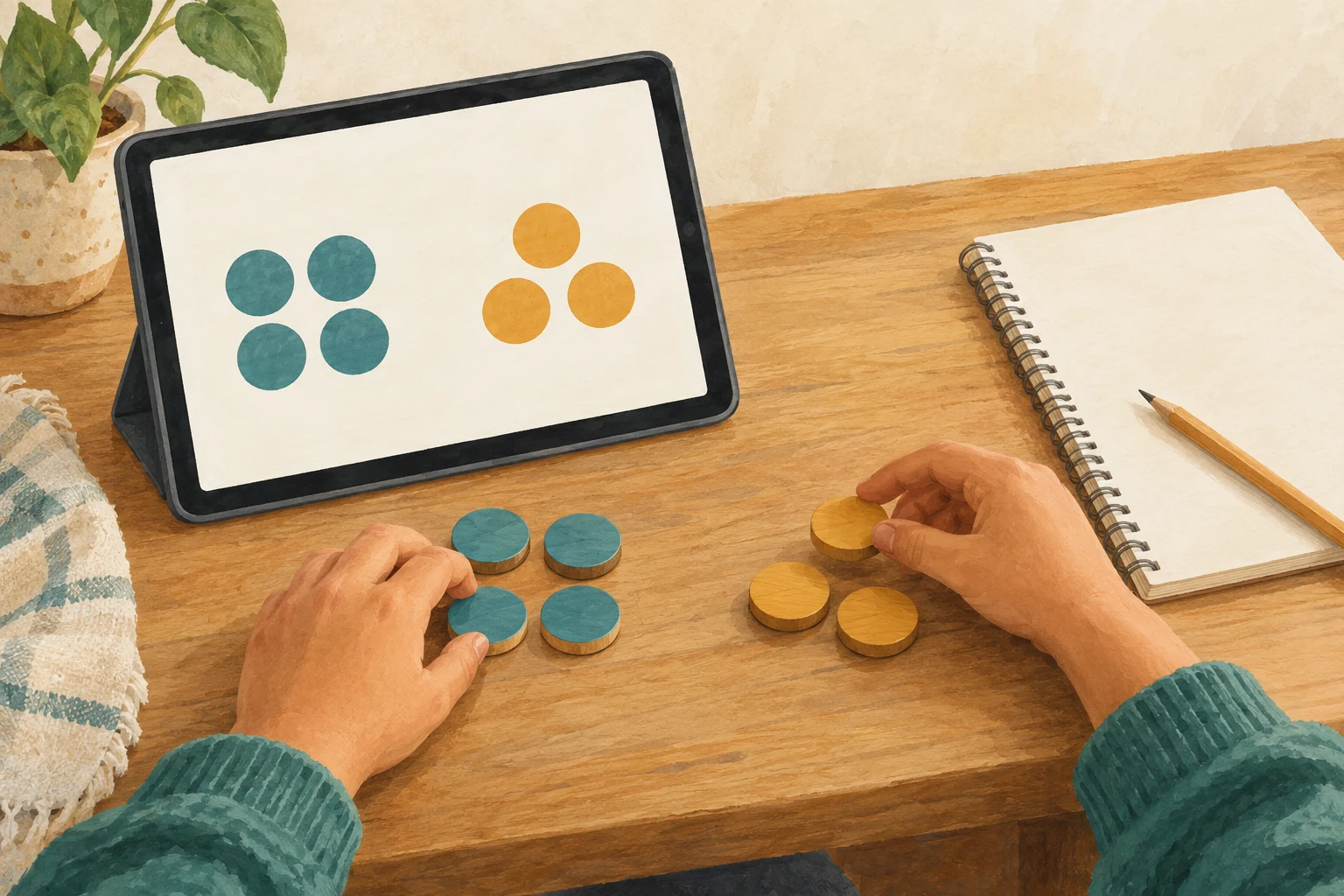
- Practice: Connect a screen activity with a paper number line and have the child explain the placement. Record any prompts or assistance needed.
- Progress check: Use different numbers in a later classroom task and compare the accuracy and assistance required with earlier work. An improved game score alone does not show that the skill transfers.
This is an illustrative teaching example, not a CODY-M test item, diagnostic threshold, or prescribed intervention. The assessor and teacher should choose the goal and progress check to fit the learner. For a calculation concern, the plan would need to specify the calculation skill instead.
For general home activities and everyday tools, use our dyscalculia resource selection guide. Those supports can complement an individualized plan; they do not reproduce the CODY assessment.
Questions to Resolve Before Choosing CODY Testing or Training
Use the full product name when asking a school, therapist, or provider:
- Instrument: Is this CODY-M 2–4 assessment, Talasia training, or another service?
- Reference group: Which grade, school half-year, language, and version support the score interpretation?
- Administration: Who supervises, and how are instruction or device difficulties handled?
- Evidence: Does the cited study evaluate this test or this training program, and which outcomes does it support?
- Follow-up: Who explains the profile and connects it with teaching goals or further evaluation?
- Access: What license, practitioner eligibility, data handling, and report access apply?
These questions make computer aided dyscalculia test and training a more concrete decision. First establish whether the named instrument fits the learner and the purpose, then discuss how its information will be used. If you need wider support options, explore our practical resources for parents, teachers, and adults.
FAQ
Is CODY-M the Test on This Website?
No. CODY-M 2–4 is a specific computer-based mathematics instrument. This website's questionnaire is a separate preliminary educational screener, and its results should not be interpreted using CODY-M norms.
Can a Low CODY-M Score Diagnose Dyscalculia?
Not on its own. The score describes performance relative to a reference group. A qualified professional must interpret it within a broader evaluation before drawing a diagnostic conclusion. Neither this website's screener nor a training score replaces that evaluation.
Can CODY-M 2–4 Assess an Adult or Teenager?
The cited manual provides norms for grades 2–4. It does not establish adult or adolescent suitability. Ask an assessor about an instrument appropriate to the learner's age and assessment purpose.
Does “Computer Aided” Mean the Child Can Take It Alone?
Computerized presentation and scoring do not remove administration requirements. Confirm supervision, permitted assistance, equipment, and interpretation arrangements with the practitioner using the test.
Is CODY Testing Free Because the App Is Downloadable?
A download does not establish free access to the assessment service. The publisher describes licensed use; check the current access conditions with the provider or practitioner.
Are CODY, Talasia, and Calcularis Interchangeable?
No. CODY is the research-project name, CODY-M is the mathematics test, Talasia is related training, and Calcularis is a separate program. Match each research claim to the instrument or intervention actually studied.
Does a Higher Training Score Show That Support Is Working?
It may show better performance within that activity. Stronger evidence of useful progress includes performance on new examples and classroom tasks related to the original learning goal, with any assistance recorded. Discuss those observations with the person overseeing support.